
Prepare for the year-end rush with an industrial lubrication checklist. Review oils, bearings, and storage practices to help reduce downtime. Contact PALCO for guidance.
As the calendar year comes to an end, most plants and workshops follow a familiar pattern. Production targets are chased hard in the final weeks, festive-season demand is still being cleared, and planning for the new financial quarter has already begun. In the middle of all these activities, maintenance tends to slip quietly down the priority list. Yet the weeks between late November and early January are among the best windows of the year to give machinery the attention it needs. Order books usually reset in January, and plants that start the new year with well-lubricated, inspected equipment are far better placed to handle the rush that follows. An industrial lubrication checklist can help maintenance teams prepare equipment for the year-end rush.
Lubrication sits at the centre of this preparation. Industry studies have long linked a large share of bearing and gearbox failures to lubrication problems, whether that means the wrong product, too little, too much, or oil and grease that has simply outlived its useful life. A structured year-end lubrication review is one of the lowest-cost ways to reduce unplanned downtime in the months ahead. This industrial lubrication checklist helps maintenance teams, plant managers, and fleet operators review lubrication systematically and reduce the risk of unplanned downtime.
Year-End Industrial Lubrication Checklist
1. Start With a Complete Lubrication Inventory
Before any oil is drained or any grease gun is picked up, it helps to know exactly what is in use across the facility. Over a year, it is common for different shifts, contractors, or new team members to introduce products that were never part of the original plan. A quick audit of the lubricant store, the shop floor, and the machines themselves often reveals duplicate products, unlabelled containers, and grades that no longer match the equipment manufacturer’s recommendations.
The year-end inventory should list every lubrication point, the product currently used, the recommended product, the quantity, and the frequency. This inventory is the foundation of the industrial lubrication checklist and the maintenance schedule for the coming year. Where possible, consolidating to fewer, well-chosen products reduces the risk of mix-ups and simplifies purchasing.
2. Check Oil Condition, Not Just Oil Level
Topping up a reservoir to the correct level is routine, but level alone says very little about whether the oil is still doing its job. Over months of operation, lubricants oxidise, pick up moisture and collect fine particles of dust and wear metal. Additives that protect against wear, rust and foaming are gradually consumed.
A simple visual check is a useful first step. Oil that has turned noticeably darker than usual, appears cloudy or milky, smells burnt, or shows sediment at the bottom of a sample bottle is a clear warning sign. For critical equipment such as hydraulic systems, compressors, turbines, and large gearboxes, an oil analysis report gives a far more reliable picture, measuring viscosity, water content, acidity, and wear metals. The end of the year is an ideal moment to send samples for analysis, because the results can guide decisions on whether to change the oil now or extend its service.
3. Change Oils That Are Due or Overdue
Once a condition has been assessed, oils that have reached the end of their service life should be replaced before the new year begins. Running a degraded lubricant through January’s peak production is a gamble that rarely pays off. Thin, oxidised oil fails to maintain a protective film, and contaminated oil acts like a mild abrasive on precision surfaces.
When changing oil, the system should be drained while it is still warm so that more of the old oil and suspended contaminants flow out. Filters should be replaced at the same time, and where sludge or varnish is visible, flushing the system before refilling is worth the extra effort. The new oil should match the viscosity grade and specification recommended for the equipment, rather than whatever happens to be in stock.
4. Re-Grease Bearings Correctly
Grease points are often the most neglected part of a lubrication programme, partly because they are numerous and partly because the effects of poor greasing take time to show. A year-end review is a good opportunity to walk every grease point, confirm that fittings are clean and working, and replenish grease with the correct product.
Over-greasing is as harmful as under-greasing. Packing a bearing with too much grease raises operating temperature, increases friction, and can damage seals, allowing contamination to enter. Following the recommended quantity and wiping fittings clean before applying grease makes a measurable difference to bearing life. Different greases should not be mixed without confirming compatibility, since some thickener types react poorly with others and lose their structure.
5. Inspect Seals, Breathers and Filters
Lubricants can only protect machinery if they stay clean and stay where they are meant to be. Worn seals let oil leak out and allow dust and water to get in. Clogged breathers cause pressure imbalances and draw contaminated air into gearboxes and reservoirs. Blocked filters either restrict flow or go into bypass, sending unfiltered oil around the system.
A careful inspection of seals, gaskets, breathers and filters should be part of every year-end review. Any visible leaks should be logged and repaired, not simply cleaned up. Desiccant breathers that have changed colour should be replaced, and filters that are near the end of their rated life should be changed rather than left to fail during peak production.
6. Prepare for Winter Operating Conditions
In many parts of India, December and January bring noticeably colder mornings, especially across the north. Lower temperatures increase oil viscosity, which means lubricants flow more slowly at start-up. Engines, compressors and hydraulic systems experience their highest wear in the first few moments after a cold start, before oil fully reaches every surface.
For equipment that operates outdoors or in unheated sheds, it is worth confirming that the lubricant grade is suitable for the lowest expected temperatures. Multigrade engine oils and hydraulic oils with a good viscosity index perform more consistently across a wider temperature range. Allowing equipment a short warm-up period before full load also helps protect components during the winter months.
7. Review Storage and Handling Practices
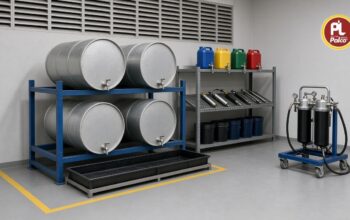
Many lubrication problems begin long before oil reaches the machine. Drums stored outdoors can draw in rainwater through their bungs as temperatures change. Open containers collect dust. Shared funnels and transfer jugs carry one product into another. A year-end walk through the lubricant store can identify simple fixes that protect product quality throughout the following year.
Good practice includes storing drums indoors or under cover, lying them on their side with bungs at the three and nine o’clock positions, keeping containers sealed when not in use, and labelling dispensing equipment clearly by product. A first-in, first-out system ensures older stock is used before it exceeds its shelf life.
8. Choose the Right Product for Each Application
The year-end review frequently reveals machines running on lubricants that are adequate but not ideal. High-temperature applications such as ovens, kilns, and heat-treatment lines need oils and greases formulated to resist oxidation and carbon formation. Heavily loaded gears and bearings benefit from extreme-pressure additives. Food, beverage, and pharmaceutical lines need NSF H1 registered food-grade lubricants wherever incidental contact with the product is possible.
Matching each application to the right product is where an experienced lubricant manufacturer adds real value. Indian manufacturers such as Palco, which has been producing lubricants, greases and industrial specialities since 1985, offer technical guidance alongside their product range, helping plants select grades that suit their equipment, operating temperatures and industry requirements. Getting this right at the start of the year prevents many of the problems that otherwise surface months later.
9. Update the Lubrication Schedule and Records
All the information gathered during the review should feed into an updated lubrication schedule for the new year. Each lubrication point should have a clear owner, product, quantity, and frequency. Digital maintenance systems make this easier, but even a well-maintained spreadsheet or wall chart is far better than relying on memory.
Records also make it possible to spot patterns over time. A bearing that needs greasing more often than its neighbours, a gearbox whose oil darkens unusually fast, or a hydraulic system that repeatedly shows high water content are all early signs of an underlying issue that deserves investigation.
10. Train the Team Before the Rush
Finally, the year-end period is a valuable time to refresh lubrication knowledge across the team. New operators may never have been shown how to read an oil sight glass, check a breather, or use a grease gun correctly. Even experienced technicians benefit from a short reminder of the plant’s standards and any changes made during the review.
A brief training session, supported by clear labels on machines and simple visual guides at lubrication points, helps ensure that the improvements made in December are maintained through the busy months that follow.
Starting the New Year on Solid Ground
The pressure to keep machines running until the very last day of the year is understandable. But the plants that consistently perform well in the first quarter are usually the ones that use the quieter year-end weeks to prepare. Following an industrial lubrication checklist takes relatively little time and money compared with the cost of a single unplanned breakdown during peak demand.
By auditing products, checking oil condition, replacing what is due, greasing correctly, inspecting seals and filters, preparing for winter, improving storage, choosing the right products, and training the team, maintenance departments can enter the new year with confidence. Well-lubricated machinery runs cooler, wears less, and delivers more reliable output, which is exactly what every business needs when the new year rush begins.