
Learn how over-greasing bearings causes heat, seal damage, and wear. Discover proper grease quantity and maintenance practices with PALCO.
In many maintenance teams, a generous shot of grease is seen as a sign of care. If a bearing is running a little warm or sounding a little rough, the natural response is to reach for the grease gun. If a fitting is due on the schedule, a few extra strokes “just to be safe” seem harmless. The thinking is simple: grease protects bearings, so more grease should mean more protection.
In reality, over-greasing bearings can cause overheating, seal damage, and premature wear.
A rolling element bearing needs a certain amount of grease to work well, and it can be harmed by having too little or too much. When a bearing housing is packed beyond what the bearing can use, the excess does not sit quietly in reserve. It is pushed, churned, and sheared by the rolling elements and cage, generating heat, building pressure, and, in many cases, forcing its way past seals or into places where it does real damage.
This is why grease quantity deserves the same attention as grease selection. A more useful question than “Has this bearing been greased?” is “Has this bearing received the right amount of grease, at the right interval?”
Why Over-Greasing Is So Common
Over-greasing rarely comes from carelessness. More often it comes from good intentions combined with limited information.
Technicians are rightly taught that poor lubrication is a frequent cause of bearing problems. The step from there to “extra grease prevents failure” is an easy one to make. Without guidance on quantity, the instinct is to keep pumping until grease appears at a seal.
Several other factors add to the problem. Lubrication schedules often state how often to grease a point but not how much. Grease guns vary widely in how much they deliver per stroke, so “two strokes” from one gun may be very different from “two strokes” from another. And because the inside of a bearing housing cannot be seen, there is no easy visual check that the cavity is already full.
The result is that a bearing may receive several times the grease it needs, week after week, while appearing on paper to be perfectly well maintained.
What Actually Happens Inside an Over-Greased Bearing
To understand why too much grease is a problem, it helps to understand how grease works. Grease is essentially a base oil held in a thickener, much like a sponge holds water. In a correctly filled bearing, much of the excess grease is pushed aside into the housing during the first period of running. A small amount stays close to the rolling elements and raceways, slowly releasing oil to maintain a thin lubricating film. The bearing then runs with very little resistance from the grease itself.
When the bearing and housing are packed too full, there is nowhere for the grease to be pushed aside. The rolling elements and cage are forced to plough through it continuously. This is known as churning, and it leads to a chain of effects.
Heat is the first. Churning a mass of grease takes energy, and that energy becomes heat through internal friction. Higher temperatures thin the base oil, reducing film thickness exactly when protection is needed.
Oxidation follows. Lubricants age faster at higher temperatures, and grease is no exception. Sustained heat speeds up the breakdown of the base oil and can cause the thickener to harden, darken, or separate. Grease that has oxidised loses its ability to lubricate effectively, and hardened deposits can restrict the movement of fresh grease into the bearing.
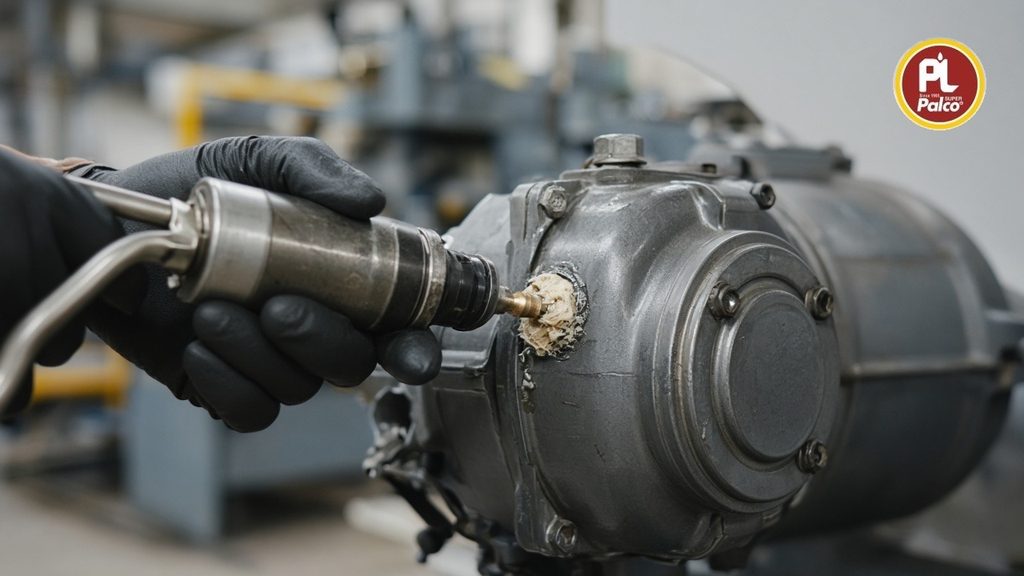
Seal damage is another common consequence. As grease is pumped into a full cavity, pressure builds. Lip seals can be pushed out of position, turned over, or torn, and once a seal is damaged, it no longer keeps contaminants out. An over-greased bearing may therefore end up admitting the very dust and water that the grease was meant to protect against.
Wasted grease is the most visible effect. Excess grease that escapes from seals collects on housings, shafts, and the surrounding floor. Purged grease is wasted money, and it attracts dirt and creates slip hazards.
Electric Motors: A Particular Risk
Electric motor bearings deserve special mention because the consequences of over-greasing can extend well beyond the bearing.
In many motors, the bearing housing sits close to the stator windings. When too much grease is added, it can be forced past the inner bearing cap or seal and into the motor’s interior. There it may coat the windings, where it can attract dust, interfere with cooling and, over time, contribute to the deterioration of winding insulation. A motor that fails electrically may in fact have started its decline at the grease fitting.
Motors also tend to run at relatively high speeds, which makes churning and heat build-up more pronounced. Many motor manufacturers specify grease quantity, interval, and a relief plug procedure on the nameplate or in the manual, and these are worth following closely.
Recognising the Signs of Over-Greasing Bearings
Because the inside of a bearing cannot be seen, over-greasing is usually identified through its effects. Common signs include:
- a rise in bearing temperature shortly after greasing;
- grease leaking from seals, shaft openings or housing joints;
- seals that are displaced, inverted or damaged;
- heavy build-up of grease on housings and surrounding surfaces;
- grease or oily residue found inside motor enclosures or on windings;
- darkened, hardened or caked grease when a bearing is opened;
- higher power draw or a change in running sound after relubrication.
A temperature rise that settles within a day or two may simply reflect excess grease being worked aside. One that stays high or climbs after every greasing points strongly to a quantity problem.
How to Calculate the Right Grease Quantity for Bearings
The right amount of grease depends on the bearing’s size, its design, its speed, and the conditions in which it operates. The bearing or equipment manufacturer’s recommendation should always come first. Where specific guidance is not available, a widely used rule of thumb gives a practical starting point for relubrication quantity:
G = 0.005 × D × B
Here, G is the grease quantity in grams, D is the bearing outside diameter in millimetres, and B is the bearing width in millimetres. For plants working in imperial units, the equivalent form is G = 0.114 × D × B, with G in ounces and D and B in inches.
As an illustration, a bearing with an outside diameter of 110 mm and a width of 27 mm would give 0.005 × 110 × 27, or roughly 15 grams per relubrication.
This formula is a guideline, not a rule. It does not account for unusual bearing designs, very high or very low speeds, heavy loads, or difficult environments, and it applies to relubrication rather than to the initial fill. For first fills, bearing manufacturers commonly suggest filling the bearing itself and only part of the free space in the housing, rather than packing the housing completely, so that excess grease has somewhere to go.
Knowing the quantity in grams is only useful if the amount delivered by the grease gun is known. A simple way to find out is to pump a set number of strokes onto a piece of paper or foil on a kitchen or laboratory scale and weigh the result. Dividing the weight by the number of strokes gives the output per stroke for that particular gun, which can then be used to convert grams into a practical number of strokes.
Working Out the Right Interval
Quantity is only half of the equation. The lubrication interval, or how often grease is added, matters just as much.
Intervals depend mainly on bearing type, size, speed, and operating temperature, with adjustments for load, vibration, contamination, and moisture. Bearing manufacturers publish charts and calculation methods that use these factors to estimate a suitable interval. As a general pattern, larger bearings and higher speeds call for more frequent relubrication, and higher temperatures shorten grease life considerably.
Bearings in dusty, wet or hot environments may need grease more often, partly to flush out contaminants, while those in clean, cool, lightly loaded applications may run much longer between services.
The key point is that quantity and interval should be set together and reviewed together. A schedule that adds a small, calculated amount at sensible intervals is far more effective than one that adds a large amount whenever someone remembers.
Under-Greasing: The Opposite Risk
None of this means grease should be applied sparingly. Under-greasing is a serious risk in its own right.
A bearing that does not receive enough grease, or does not receive it often enough, will eventually run with an inadequate lubricating film. Metal-to-metal contact between rolling elements and raceways leads to increased friction, surface distress, wear, and, in time, failure.
The goal is not less grease, but the correct amount. Over-greasing and under-greasing are two sides of the same problem: grease quantity and timing that have not been matched to the needs of the bearing.
Mixing Incompatible Greases
Adding grease to a bearing assumes that the new grease will work happily with whatever is already inside. That is not always true.
Greases are made with different thickener types, such as lithium, lithium complex, calcium, calcium sulphonate, aluminium complex, polyurea and clay-based thickeners, and with different base oils, including mineral and various synthetic types. Some combinations are compatible, while others are not. When incompatible greases are mixed, the result can be a softened grease that runs out of the bearing, a hardened grease that no longer releases oil, or a mixture with reduced temperature resistance and load-carrying ability.
The risk often arises from routine decisions, such as a change of supplier or a grease used during an emergency repair.
Where a change of grease is necessary, it helps to check compatibility with the supplier first, purge out as much of the old grease as practical, and monitor the bearing more closely for a period after the changeover. Dedicated, clearly labelled grease guns for each product reduce the chance of accidental mixing.
Practical Best Practices for Getting It Right
Getting grease quantity right relies on clear information, suitable tools, and consistent habits rather than complex technology.
A documented lubrication schedule is the foundation. Each grease point should have a defined grease type, quantity, and interval, ideally recorded on a lubrication chart or in the maintenance system. Stating quantity in both grams and strokes removes guesswork.
Calibrated grease guns turn that schedule into practice. Checking the output per stroke when a gun is first issued, and rechecking it periodically, helps ensure that the intended quantity is actually delivered.
Purge or relief plugs help protect seals and windings. Where a housing has a drain or relief plug, removing it before greasing and running the equipment for a period afterwards allows excess grease to escape rather than building pressure. The plug can then be refitted once purging has stopped. Where no relief route exists, greasing slowly and with care becomes even more important.
Clean fittings and slow application matter too. Wiping the grease nipple and the gun nozzle before each application prevents dirt from being pushed into the bearing. Pumping slowly, rather than forcing grease in quickly, gives grease time to distribute and reduces sudden pressure build-up.
Training ties these practices together. When technicians understand why too much grease can be as harmful as too little, and how to read a schedule expressed in grams and strokes, they are far less likely to add extra “for safety”.
Condition monitoring adds a further layer of confidence. Temperature checks, vibration analysis and ultrasonic monitoring can all help show how a bearing responds to relubrication. Ultrasonic instruments, in particular, are widely used to guide greasing in real time: a technician listens to the bearing while adding grease, stopping once the friction signal has dropped to a stable level, rather than relying only on a fixed number of strokes. Over time, this data can fine-tune quantity and interval for individual bearings.
The Right Amount Is the Best Protection
Grease is one of the simplest and most effective ways to protect rolling element bearings, but its value depends on how it is applied. The right PAL EP grease, in the right quantity, at the right interval, allows a bearing to run cool, quiet, and protected. Too much can cause heat, oxidation, seal damage, and contamination of nearby components, while too little leaves surfaces exposed to wear.
For manufacturers such as Paras Lubricants Limited, which produces a range of industrial greases for different loads, speeds, and operating conditions, choosing the right product is only part of the picture. For suitable bearing applications, MegaLife multipurpose grease may be an option, depending on the bearing manufacturer’s lubrication requirements. The application method of grease in the plant significantly influences bearing performance. PALCO’s technical team can help users select suitable grease and understand the correct quantity and relubrication practices for their equipment.
The most useful question at the grease point is therefore not simply, “Has this bearing been greased?”
It is, “Has this bearing been given what it actually needs?”
That shift may appear small, but it turns greasing from a habit into a measured practice, and that is where longer bearing life often begins.