

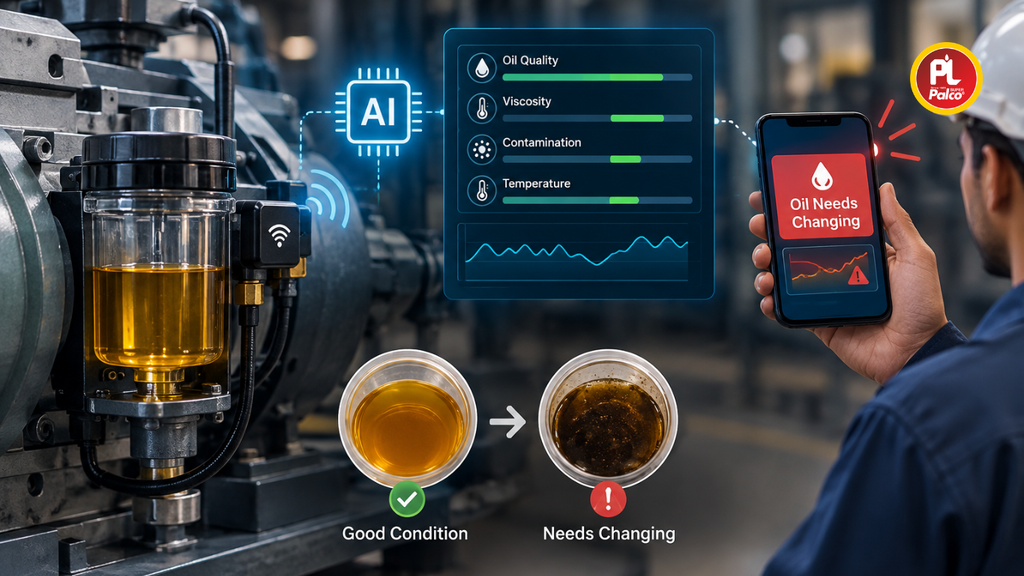
For decades, lubricant maintenance has largely followed a familiar formula: operate a machine for a specified number of hours or kilometres, change the oil, replace the filter, and repeat the cycle.
The system is simple, predictable, and easy to manage. But it also raises an important question.
What if the lubricant still has considerable useful life remaining when it is replaced? Or, more importantly, what if the lubricant begins deteriorating much earlier than the scheduled replacement interval?
This is where AI lubricant condition monitoring, intelligent sensors, and data analytics are beginning to change the way industries think about lubrication.
Instead of asking, “How long has this oil been in service?”, future maintenance systems may increasingly ask a more useful question:
“What condition is the oil actually in right now?”
The Problem with Fixed Oil Change Intervals
Oil change intervals are generally established using operating experience, equipment manufacturer recommendations, lubricant specifications, and expected service conditions.
They are extremely useful, but actual operating conditions are rarely identical from one machine to another.
Consider two identical machines using the same lubricant.
One operates for eight hours a day in a relatively clean and temperature-controlled environment. The other works continuously in high temperatures, dusty surroundings, and under heavy loads.
Even if both machines have completed the same number of operating hours, their lubricants may not be in the same condition.
Heat can accelerate oxidation. Moisture can contaminate oil. Dust can enter through seals or breathers. Fuel dilution can affect engine oils. Extreme loading can increase wear debris. Additives gradually deplete as they perform their protective functions.
Therefore, time alone cannot always tell the complete story of lubricant health.
This is one reason condition-based maintenance is gaining attention across industrial operations.
Oil Can Tell Us a Lot About the Machine
Lubricating oil does much more than reduce friction.
As it circulates through an engine, gearbox, hydraulic system, or other mechanical equipment, it continuously comes into contact with internal components. In the process, it can collect valuable information about what is happening inside the machine.
Wear particles may indicate component deterioration.
Water contamination can signal leakage or condensation.
A change in viscosity can indicate lubricant degradation, contamination, or excessive thermal stress.
Soot concentration can provide useful information in diesel engine applications.
Changes in acidity, oxidation, or additive condition can help indicate the ageing of the lubricant.
This is why lubricant analysis has long been used as a valuable tool in equipment condition monitoring.
Research into online lubricant sensors has explored the measurement of parameters including wear debris, water contamination, viscosity, aeration, soot, and other lubricant characteristics, allowing the oil to act almost like a source of information about machine health.
The major difference today is that technology is making it possible to collect some of this information continuously rather than waiting for periodic laboratory analysis.
From Oil Sampling to Real-Time Monitoring
Traditional oil analysis generally involves taking a lubricant sample from equipment and sending it to a laboratory.
The laboratory may examine characteristics such as viscosity, contamination levels, elemental composition, oxidation, and wear metals.
This approach remains extremely valuable because detailed laboratory analysis can provide information that a simple sensor cannot.
However, there is an unavoidable delay between taking the sample, testing it, and receiving the results.
Online condition monitoring takes a different approach.
Sensors installed within or around lubrication systems can continuously observe selected parameters while equipment is operating.
Depending on the application and sensor technology, these systems may monitor characteristics such as:
- Oil temperature
- Moisture contamination
- Changes in dielectric properties
- Viscosity-related characteristics
- Wear particle concentration
- Particle size
- Soot
- Fuel contamination
- Oxidation-related changes
- Lubrication system pressure and flow
The objective is not necessarily to replace laboratory testing. Instead, continuous monitoring can provide another layer of information between laboratory tests.
A sudden change in lubricant condition could potentially trigger an inspection much earlier than a scheduled maintenance programme would have.
AI Lubricant Condition Monitoring
Collecting sensor data is only one part of the challenge.
Modern industrial machines can generate enormous quantities of information.
Temperature readings may change every few seconds. Wear particle sensors can continuously detect contamination. Vibration, pressure, load, and operating speed may also fluctuate throughout a machine’s working cycle.
A human maintenance engineer cannot realistically examine every individual data point.
This is where machine learning and artificial intelligence become useful.
Rather than looking at one measurement in isolation, an AI-based system can examine patterns across large quantities of historical and real-time data.
For example, the system might observe that:
- Lubricant temperature has gradually increased
- Wear particle concentration has started rising
- Operating load has remained constant
- Vibration levels have changed slightly
- and lubricant properties are moving away from their normal operating pattern.
Individually, none of these changes may necessarily indicate an immediate problem.
Combined, however, they may reveal a developing abnormal condition.
Research into AI-based lubricant condition monitoring has already explored statistical, model-based, artificial intelligence, and hybrid approaches for supporting maintenance decisions.
The shift is therefore from simply measuring oil condition to potentially interpreting what changes in oil condition mean for the machine.
Can AI Predict Lubricant Condition and Oil Changes?
This is one of the most interesting areas of development.
Traditional maintenance works largely according to predefined limits.
Predictive maintenance attempts to estimate what is likely to happen next.
Instead of simply detecting that lubricant properties have crossed an alarm threshold, AI lubricant condition monitoring systems can analyse trends to identify whether the lubricant is approaching a condition in which maintenance may soon be required.
Recent research published in 2026 has investigated deep-learning approaches for lubricating-oil fault prognosis in diesel engines. These models use multiple lubricant parameters and time-series analysis to identify abnormal trends while accounting for uncertainty.
Other research is exploring how artificial intelligence can evaluate lubricant degradation through techniques ranging from sensor arrays to imaging and infrared analysis.
This does not mean that every machine will suddenly decide its own oil change interval.
Instead, the technology points towards a maintenance environment where operators have far more information available before making that decision.
AI Can Also Watch What Is Wearing Inside the Machine
Perhaps one of the most valuable developments involves wear debris monitoring.
Tiny metallic particles inside lubricating oil can provide clues about internal mechanical wear.
The quantity, size, and type of these particles may help engineers understand whether wear conditions are changing.
Emerging sensor technologies are becoming increasingly sophisticated in this area. Research published in 2026 demonstrated a real-time oil-monitoring sensor capable of distinguishing wear particles according to characteristics including size, concentration, and material type. Machine-learning techniques then interpreted those signals for equipment condition monitoring.
This illustrates a major shift in lubrication technology.
The lubricant is no longer viewed only as something that protects the machine.
It can also become a diagnostic medium that carries information about the machine’s internal condition.
Moving from Preventive Maintenance to Predictive Maintenance
The traditional preventive maintenance philosophy is based on preventing problems by servicing equipment before failure occurs.
Predictive maintenance takes this idea further.
Instead of performing maintenance simply because a particular number of hours has passed, operators use actual machine data to determine when maintenance may be necessary.
Consider an industrial gearbox.
Under a conventional maintenance plan, the lubricant might be changed after a predefined service period.
Under a condition-based system, oil quality, temperature, contamination, and wear trends could also be monitored.
If the lubricant remains in good condition under controlled operation, the maintenance team has better information on which to base its decisions.
If contamination suddenly increases, the system may identify the developing problem much earlier.
The real value is therefore not simply extending oil drain intervals.
It is making maintenance decisions based on better information.
The Potential Benefits for Industry
When applied correctly, intelligent lubricant monitoring can offer several operational advantages.
Earlier Detection of Problems
Abnormal lubricant conditions can sometimes appear before severe mechanical failure becomes obvious.
Detecting these changes early gives maintenance teams more time to investigate.
Reduced Unplanned Downtime
Unexpected equipment failure can interrupt production, affect delivery schedules, and increase repair costs.
Predictive monitoring aims to identify developing problems before they become major breakdowns.
Better Use of Lubricants
Changing lubricant too early wastes a usable resource.
Changing it too late risks equipment damage.
Condition monitoring can help industries move closer to the optimum point.
Improved Maintenance Planning
If maintenance teams can identify developing lubricant or equipment problems in advance, shutdowns and servicing can potentially be planned more efficiently.
Better Understanding of Equipment
Over time, condition-monitoring systems create a history of how equipment behaves under different loads, temperatures, and operating environments.
That information itself can become valuable for maintenance planning.
But AI Does Not Eliminate the Need for Lubrication Expertise
Despite its potential, artificial intelligence is not a substitute for correct lubricant selection, proper maintenance practices, or engineering knowledge.
An AI model can only work with the quality of the information it receives.
Sensors must be installed correctly.
Data must be reliable.
Operating conditions must be understood.
Alarm levels must be appropriate for the equipment.
The correct lubricant must still be selected according to factors such as viscosity requirements, temperature, load, speed, material compatibility and OEM recommendations.
Sensor readings can also be affected by temperature, contamination and cross-sensitivity between different lubricant characteristics. Research into neural-network-supported sensor arrays has specifically explored the challenge of interpreting overlapping sensor responses while compensating for changing temperatures.
Therefore, intelligent lubrication should be viewed as a combination of lubricant technology, sensors, data, and human engineering expertise.
What Does This Mean for the Future of Lubricants?
Lubricants themselves are becoming more sophisticated.
Modern formulations must operate in machines that are increasingly powerful, precise, compact, and demanding.
At the same time, the way those lubricants are monitored is also evolving.
In the future, industrial lubrication programmes may increasingly combine:
high-performance lubricants, connected sensors, automated oil analysis, equipment operating data, predictive algorithms and intelligent maintenance platforms.
The result could be a shift from scheduled lubrication towards smart lubrication management.
Rather than treating lubricant replacement as a routine calendar event, organisations may increasingly treat lubrication as a measurable part of equipment health.
Lubrication Is Becoming Part of the Data Economy
A bottle or drum of lubricant may look much the same as it did years ago, but the environment in which that lubricant operates is changing rapidly.
Factories are becoming connected.
Machines are producing more data.
Maintenance programmes are becoming more predictive.
And artificial intelligence is learning how to identify patterns that would be difficult for humans to recognise manually.
For lubricant manufacturers such as Paras Lubricants Limited, this evolution represents an important development in the industry. The future of lubrication will not depend only on developing oils and greases capable of protecting modern equipment. It will increasingly involve understanding how those lubricants perform throughout their working life.
Machines may not literally speak.
But through sensors, lubricant analysis, and intelligent data interpretation, they are becoming much better at telling us what is happening inside them.
And one day, instead of simply reminding us that an oil change is due, the machine may be able to tell us whether it actually needs one.