

Learn lubricant storage and handling practices to prevent oil contamination and protect machinery. Read PALCO’s guide to cleaner lubrication.
In most industrial plants, lubricant contamination is treated as something that happens inside the machine, while lubricant storage and handling are often overlooked. Dust can enter through worn seals, water can accumulate in reservoirs, and wear particles can build up in gearboxes. This creates a common misconception: oil arriving in a sealed drum is clean and remains clean until it is put into service.
In reality, that is not always the case.
A large share of the contamination found in machinery can be introduced long before the lubricant reaches the machine. It can enter while drums sit in the yard, while oil is decanted into open containers, while a funnel is reused from one product to another, or while a grease gun lies on a workbench between jobs. By the time the lubricant is added to the equipment, it may already carry particles, moisture, or traces of another product.
This is why contamination control should not begin at the machine. A more useful question than “How is contamination kept out of the equipment?” is “At what point in the storage and handling chain could contamination have entered this lubricant?”
New Oil Is Not Automatically Clean Oil
Fresh lubricant is manufactured and packed under controlled conditions, but “new” and “clean” do not always mean the same thing. Depending on the product, the application, and how it has been transported and stored, new oil may not meet the cleanliness level a sensitive system requires.
This matters most for equipment with tight internal clearances. Hydraulic systems with servo or proportional valves, high-speed bearings, precision spindles, and turbine systems can be sensitive to particles that are far too small to see. For such equipment, plants often set target cleanliness levels using ISO cleanliness codes, which describe how many particles of different sizes are present in a given volume of oil.
Each time a container is opened, a hose is connected, or oil is poured into a secondary vessel, there is an opportunity for dirt or moisture to enter.
The practical point is that lubricant cleanliness should be considered at every stage, not assumed at delivery.
Lubricant Storage and Handling: Main Types of Contamination
Contamination introduced during storage and handling generally falls into four broad groups, each with a different effect on lubricant performance.
Solid particles, such as dust, sand, fibres, rust flakes and metal fines, are the most familiar. They can cause abrasive wear, block filters, damage valve surfaces and speed up the wear of bearings and gears.
Water is the second major contaminant. It can enter as free water from rain or washdown or as moisture absorbed from humid air. Water can reduce film strength, promote rust and corrosion, react with certain additives, encourage microbial growth in some fluids, and contribute to emulsions or sludge.
Cross-contamination occurs when one lubricant is mixed with another. Even small amounts of the wrong product can change viscosity, dilute additive chemistry or cause compatibility problems, particularly where different additive systems or grease thickeners are involved.
Heat and oxidation can also affect lubricants in storage. Containers exposed to direct sunlight or kept near hot process areas may undergo repeated heating, which can speed up ageing, darken the product, or affect sensitive additives over long periods.
Outdoor Drum Storage, Orientation and the “Breathing” Effect
Storing drums outdoors is common in many plants because indoor space is limited. However, outdoor storage creates one of the least visible contamination risks: drum breathing.
As the temperature rises during the day, the air and oil inside a drum expand, and some air is pushed out past the bungs and seals. As temperatures fall at night, the contents contract, and the drum draws air back in. If rainwater, dew, or dust has collected on the drum head, it can be pulled inside along with that air. Over weeks or months, this daily cycle can introduce significant moisture into a drum that has never been opened.
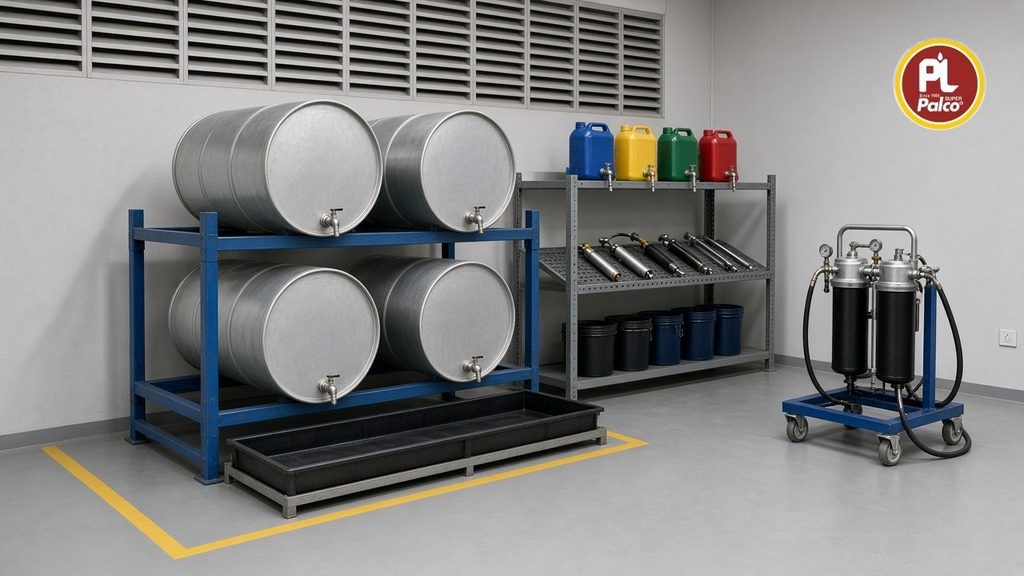
Orientation influences how much of this happens. A drum stored upright allows water to pool around the bung openings. Storing drums horizontally on racks, with the bungs at roughly the three o’clock and nine o’clock positions, keeps both bungs below the oil level, so the oil covers the seals and helps prevent moist air being drawn in. Where drums must stand upright, tilting them slightly so water runs off, or using drum covers, can reduce pooling.
Seal integrity matters just as much. Bungs should be properly tightened after each use, damaged gaskets replaced, and drums dented around the rim or bung area treated with caution. Once a drum is opened, the factory seal no longer protects the contents, so the way it is closed and stored afterwards becomes the main defence.
Where outdoor storage cannot be avoided, a roof, drum covers, or a shaded and well-drained area can reduce these risks considerably, while also protecting labels from fading and peeling.
Shelf Life and First-In, First-Out Stock Rotation
Lubricants do not last indefinitely in storage. Most mineral and synthetic oils remain stable for a long time under good conditions, but storage life depends on the product type, its additive chemistry, packaging, and storage environment. Some products, such as certain greases, emulsifiable fluids and products with specialised additives, may be more sensitive to long storage periods.
Over time, problems can include additive settling, oil separation in greases, moisture pick-up and gradual oxidation. This is why stock rotation is important. A first-in, first-out (FIFO) system ensures that older stock is used before newer deliveries. Simple practices can support this:
clearly marking the receipt date on every container;
arranging stock so older containers are easily reached first;
recording batch details at receipt;
reviewing slow-moving inventory regularly.
Checking product condition before using older stock.
Where a lubricant has been in storage for a long time, or the storage conditions are uncertain, a visual check and, if necessary, a laboratory check before use can prevent problems later.
Labelling and Colour Coding Prevent Costly Mix-Ups
Cross-contamination is often the result of simple confusion rather than carelessness. When several lubricants are stored together in similar containers, and transfer cans or top-up bottles carry no clear identification, the risk of using the wrong product rises sharply.
Consider a plant where a hydraulic oil and a gear oil of similar appearance are both decanted into unmarked containers. A technician topping up a hydraulic reservoir may pick up the wrong container. The machine may continue operating, but viscosity and additive performance may no longer match what the system requires.
A clear identification system helps prevent such errors. Many plants use colour coding or shape coding that links each lubricant to specific dispensing containers, storage positions and machine fill points. Labels on the storage container, the transfer container and the machine itself should all point to the same product.
Labels should be durable and resistant to oil and moisture, and adding the viscosity grade and application can provide an extra safeguard.
Dispensing Equipment, Open Containers and Top-Up Practices
The transfer from storage container to machine is often the stage at which the most contamination is introduced.
Open buckets, cut-down drums, uncovered jugs and shared funnels are still used in many facilities. These containers are exposed to airborne dust and moisture, may be stored on dirty floors, and are often used for different products. A funnel that is wiped with a rag and set down on a workbench can easily carry particles and traces of a previous lubricant into the next machine.
Top-up practices deserve particular attention. Small, frequent top-ups are common, and each one creates another chance for contamination. Removing a fill cap in a dusty environment or pouring oil through an unclean opening can introduce particles directly into the system.
Improvements in this area usually involve:
using sealed, dedicated transfer containers for each lubricant;
keeping dispensing equipment clean and covered when not in use;
avoiding shared funnels and open buckets;
Clean fill points before opening them.
Using quick-connect fittings where practical.
Grease Handling Needs the Same Discipline
Grease is often viewed as more forgiving than oil because it is thicker and less likely to flow. In practice, grease can carry contamination just as easily, and once particles are embedded in grease, they are difficult to remove.
Grease guns are a common source of the problem. A gun left on a dusty surface, a nozzle that is not wiped before use, or a grease fitting that is not cleaned before greasing can all push dirt directly into a bearing. Because grease goes straight to the point of lubrication, there is usually no filtration in between.
Mixing is another concern. Different greases can use different thickener types, and some combinations may be incompatible. Using the same grease gun for different products without proper identification can cause softening, hardening or loss of performance.
Cartridges help reduce some handling risks, but they still need clean handling. Cartridges should be stored sealed and upright, used in order of receipt, and loaded into clean guns. Bulk grease containers should be kept covered, and grease should not be scooped out with tools that have been exposed to dirt.
Assigning grease guns to specific products, marking them clearly and cleaning both the nozzle and the fitting before each application can significantly reduce contamination at the point of use.
Filtration During Transfer and Desiccant Breathers
Even with careful storage, filtration is often the most dependable way of ensuring that lubricant entering a sensitive machine meets the required cleanliness level.
Filtering oil during transfer, through a filter cart or dispensing system fitted with a suitable filter, removes particles that may have entered during transport or storage. For critical hydraulic and circulating systems, filtering new oil before it enters the reservoir can be an effective way to protect components from the start.
Breathers are another important control. Reservoirs, storage tanks, and gearboxes draw in air as oil levels and temperatures change. A standard vent lets in dust and moisture along with that air. Desiccant breathers combine particle filtration with a drying agent that absorbs moisture from incoming air.
They are particularly useful in humid environments, outdoor installations and tanks with frequent level changes, but they need monitoring because the desiccant becomes saturated over time; many include a colour indicator to show when replacement is due.
Storage Room Conditions Matter
A dedicated lubricant storage area can make contamination control far easier. The ideal store is clean, dry, well ventilated and protected from extreme temperatures and direct sunlight.
Stores located next to production areas may be exposed to dust, fumes or heat, and stores shared with parts, tools or cleaning chemicals increase the risk of contamination and confusion.
Key storage room considerations include:
protection from rain, dust and direct sunlight;
stable and moderate temperatures;
good housekeeping and clean floors;
racking that keeps containers off the floor;
spill containment and safe handling arrangements.
separation from incompatible chemicals.
The storage area also influences behaviour. A well-organised, clearly labelled store encourages careful handling, while a cluttered and poorly maintained area tends to encourage shortcuts.
Training and Ownership Turn Procedures into Practice
Good storage and handling procedures only work if they are followed consistently. In many plants, the people who handle lubricants every day, including stores staff, technicians and contractors, may not have received specific training on contamination control.
Training does not need to be complex. It should explain how particles and water damage machinery and which practices prevent it. When technicians understand that a small amount of dust in a reservoir can shorten the life of a valve or bearing, they are more likely to treat lubricant handling as a precision task rather than a routine chore.
Ownership is equally important. Lubricant storage often falls between departments, with stores, maintenance and production each assuming another is responsible. Assigning clear responsibility for the storage area, dispensing equipment and stock rotation helps ensure standards are maintained over time.
Recognising When Contamination Came from Handling
When oil analysis or inspection reveals contamination, the source is not always the machine itself. Several signs can point towards the storage and handling chain:
contamination found shortly after an oil change or top-up;
high particle or water levels in new oil taken from storage;
similar contamination appearing across several unrelated machines;
unexpected changes in viscosity or additive levels after top-up;
cloudy or hazy oil drawn from stored drums.
grease with visible grit, separation or unusual texture.
In such cases, sampling oil from storage containers and transfer equipment, not just from the machine, can help locate the source. Replacing filters or seals on the equipment will not solve a problem that begins in the drum store.
A Practical Storage and Handling Checklist
A review of storage and handling practices can begin with a few straightforward questions:
Are drums stored indoors, covered, or protected from rain and direct sunlight?
Are drums stored horizontally, or protected from water pooling on top?
Are bungs and seals tightened and in good condition after every use?
Is stock rotated on a first-in, first-out basis, with receipt dates recorded?
Are all storage and transfer containers clearly labelled or colour coded?
Are dedicated, sealed transfer containers used for each lubricant?
Are fill points and grease fittings cleaned before lubricant is added?
Are grease guns assigned to specific products and kept clean?
Is oil filtered before entering sensitive systems?
Are desiccant breathers fitted and replaced when saturated?
Is the storage area clean, dry and well organised?
Have the people handling lubricants been trained, and is responsibility clearly assigned?
The answers often reveal simple, low-cost improvements.
Lubricant Storage and Handling: Clean Lubrication Starts at the Store
Lubricant quality is often judged by formulation, specification and performance in the machine. These factors are important, but they only deliver their full value if the product reaches the machine in the condition intended.
For lubricant manufacturers such as Paras Lubricants Limited, product quality is controlled through formulation, manufacturing and testing before dispatch. Once the lubricant reaches a plant, however, storage and handling practices largely determine whether that quality is preserved all the way to the point of use.
The most useful question in contamination control is therefore not simply, “How clean is the oil inside the machine?”
It is, “How clean was the oil when it went in?” That shift may appear small, but it moves contamination control upstream, to the drum yard, the store room and the grease gun, where many lubrication problems quietly begin.