
PALCO provides lubricant contract manufacturing, private labelling, blending, and packaging. Build your brand with tailored production solutions—enquire now.
A lubricant brand can be launched in a few months through lubricant contract manufacturing. The trust behind it takes years to build, and one inconsistent batch can damage it.
That gap explains why contract manufacturing has become one of the most important, and most misunderstood, parts of the lubricants and greases business. Distributors, regional brands, OEM aftermarket programmes and new entrants all want the same thing: a product that performs, looks right on the shelf and arrives on time, without the cost of building a blending plant.
Choosing the partner who makes it is not a simple purchasing decision. It is closer to choosing a co-founder for the product.
Why Brands Choose Lubricant Contract Manufacturing
The reasons are practical. A modern lubricant plant needs blending kettles, grease reactors, storage tanks, filling lines, a quality control laboratory, trained chemists, regulatory know-how, and a steady supply of base oils and additives. For a business whose real strength is distribution, sales, or local market knowledge, putting that money into fixed assets often makes little sense.
Contract manufacturing, whether it is called private label, white label, or toll blending, lets each side focus on what it does best. The brand owner knows which viscosity grades move fastest, which pack sizes workshops prefer, and which price points work. The manufacturer brings formulation, production discipline, testing, and packaging capability.
When the relationship works, the brand grows faster than it could alone. When it fails, the brand takes the blame in the market, not the plant.
Formulation expertise comes before price.
Many contract discussions start and end with price per litre. That is understandable but risky. Two products can carry the same SAE grade and API classification on the label and still differ in additive chemistry, base oil quality, and real-world durability.
In lubricant contract manufacturing, formulation expertise should take priority over price because the right base oils, additives, and performance requirements determine product suitability.
A capable partner should be able to discuss the application, not just the specification. What equipment will the product protect? What climate, load, and drain interval will it face? For greases, which thickener system suits the job: lithium, lithium complex, calcium sulfonate, polyurea or something else? The answers shape the formulation, and a manufacturer with genuine R&D depth will ask these questions before quoting.
Explore PALCO’s range of industrial oils and lubricants for different machinery and industrial applications.
Quality control that is visible, not assumed
Every manufacturer claims strict quality control. Buyers should look for evidence. Is incoming base oil and additive tested before use? Is every finished batch checked against defined parameters such as viscosity, flash point, TBN, pour point or, for greases, penetration and dropping point? Are certificates of analysis issued per batch? Are retention samples kept?
Certifications such as ISO 9001 show that a quality management system exists. The day-to-day discipline inside the laboratory is what keeps the product consistent.
Consistency is the real product.
For a private label brand, the customer is buying repeatability. The tenth order must match the first in colour, viscosity and performance. Automated process control, documented batch records, and traceability matter here. If a complaint comes in from the field, the manufacturer should be able to trace that batch back to its raw materials and process conditions.
Packaging and scalability
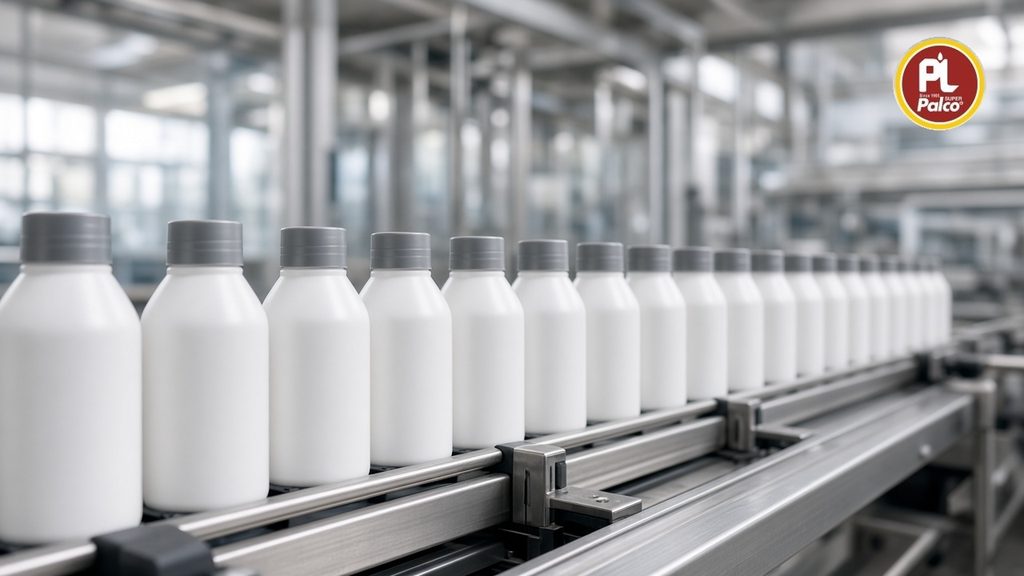
Packaging is part of the brand experience. A capable partner should support the formats the market actually buys, from small retail bottles and grease cartridges to pails, drums, IBCs and bulk. It should also handle label design, barcodes, language requirements and export cartons where needed.
Scalability matters just as much. A brand may start with a modest trial order and grow quickly. The partner should be able to run small, medium and large batches without letting quality slip as volumes rise.
Confidentiality and compliance
A private label formulation and its customer list are commercial assets. Clear confidentiality terms, separation of customer-specific labels and stock, and respect for the brand owner’s market should be agreed at the start.
Compliance is equally important. Depending on the product and market, this can include API licensing rules, OEM approval conditions, food-grade registrations, BIS or other national standards, and export documentation. A partner that understands these frameworks reduces the risk of costly relabelling or rejected shipments.
Common pitfalls
Several mistakes appear again and again in contract manufacturing relationships:
- Choosing on price alone, then finding that the cheaper formulation fails in the field.
- Relying on a spec sheet without asking for batch test data or retention samples.
- Not agreeing on change control, so formulations or raw materials are changed without notice.
- Underestimating packaging lead times, label approvals, and artwork changes.
- Putting performance claims on the label that the formulation has not been tested to support.
- Treating the manufacturer as a vendor rather than a technical partner and skipping regular review meetings.
Most of these can be avoided with a written technical agreement, clear specifications, and a habit of sharing market feedback.
PALCO’s Lubricant Contract Manufacturing Services
Paras Lubricants Limited, operating under the PALCO brand since 1985, offers lubricant contract manufacturing, private label, and contract blending services for lubricants, greases, coolants, and auto care products. The company runs two manufacturing units in Daman (U.T.), and its integrated facility handles blending, filling, packaging, and logistics, so partners can focus on brand building and market growth.
According to the company, production is digitally monitored through automated process control (SCADA), which supports consistency and traceability across batches. Dedicated R&D teams support formulation development, optimisation and technical validation, with products validated in line with IS, ASTM, API, JASO and NLGI standards. Base oils and additives are sourced from globally approved suppliers, and batch-level quality checks are carried out before domestic and international delivery.
The published blending capacity at the contract manufacturing facility is 146,700 KL per year for lubricating oils, 9,000 MT per year for grease and 21,000 MT per year for coolants. Packaging ranges from retail packs such as 100 ml, 500 ml, 1 L, and 4 L bottles, pouches, and grease cartridges up to 20 L and 26 L packs, 50 L, 200 L and 210 L drums, 1000 L IBCs, and tankers and flexis for bulk shipments. The facility is set up for small, medium, and large-scale production.
On the compliance side, the company holds ISO 9001:2015, ISO 14001:2015 and ISO 45001:2018 certifications and is recognised as a One Star Export House. Its listed product approvals include API certification, Volvo VDS-3 and JASO MA2, along with NSF registration for food-industry applications.
The stated aim is to work as an extension of the partner’s business, with an emphasis on quality, confidentiality and long-term partnership.
The question worth asking
The strongest contract manufacturing relationships rarely start with “What is the price?” They start with “Can this partner protect the brand when no one is watching the blending kettle?”
For brand owners and distributors who have outsourced manufacturing, what has mattered most in a partner, and what lesson came at the highest cost?