

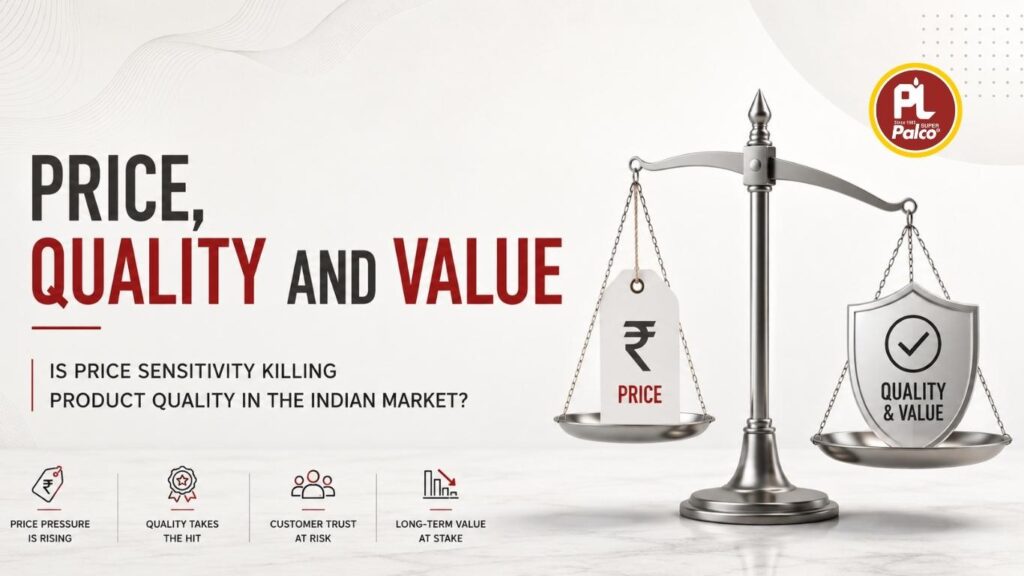
Understand price sensitivity and how customer buying decisions are influenced by pricing, helping businesses build value, trust, and stronger sales.
Price sensitivity has always been one of the strongest forces in the Indian market. It influences consumer behaviour, dealer decisions, procurement strategies, production planning, and even brand positioning. In a country as competitive and diverse as India, price sensitivity is not unusual. It is a natural outcome of a market where every rupee is measured, compared, negotiated, and justified.
But today, the conversation needs to go deeper.
Has price sensitivity become so aggressive that it is slowly damaging product quality in the Indian market? Are we creating a business environment where cheaper is rewarded more than better? And if that is true, what is the long-term cost of this behaviour?
From a finance point of view, this is not an emotional question. It is a question of numbers, margins, hidden costs, and long-term value.
When Price Pressure Enters the Product
Every product has a cost structure. As price sensitivity increases, manufacturers face growing pressure to reduce costs without reducing customer expectations. Raw materials, formulation, manufacturing, packaging, testing, compliance, labour, logistics, credit period, dealer margin, warranty risk, and after-sales support all sit inside the final price. When the market demands a lower price without reducing expectations, the pressure does not disappear. It shifts.
Sometimes it shifts to the manufacturer’s margin. Sometimes it shifts to the distributor’s profitability. Sometimes it is absorbed through better efficiency. But when the pressure becomes too high, it often starts entering the product itself.
That is where the danger begins.
Quality rarely dies in one big decision. It usually weakens through small compromises that look harmless in isolation. A slightly cheaper raw material. A thinner packaging layer. A reduced testing cycle. A supplier selected only because of cost. A specification adjusted quietly. A process skipped because it saves time.
On paper, these decisions may improve margins for a short period. In reality, they often create future losses.
The customer may not notice the difference immediately. The quotation looks attractive. The dealer feels competitive. The procurement team feels satisfied. The product moves faster because it is cheaper.
But after some time, the numbers begin to show the truth.
The Hidden Accounting of Poor Quality
Excessive price sensitivity often leads businesses to compromise on quality, resulting in higher complaints, repeat order losses, warranty claims, and reduced customer trust. Field failures rise. Warranty claims become frequent. Sales teams spend more time defending the product than selling it. Dealers lose confidence. Customers start comparing alternatives. The brand loses trust, and eventually, it loses pricing power.
This is the hidden accounting of poor quality.
A company may save money in production, but lose much more in the market. The damage may not appear instantly in the profit and loss statement, but it slowly appears in customer behaviour, brand perception, and future revenue.
Some costs are visible. Some costs are silent.
The visible cost is the discount given to win the order.
The silent cost is the trust lost when the product fails to perform.
In finance, cost reduction is valuable only when it removes waste. It becomes dangerous when it removes value. There is a major difference between efficiency and compromise. Efficiency strengthens the business. Compromise weakens it from within.
Low Price Is Not Always Better Value
The Indian customer is price-sensitive, but not foolish. The Indian customer wants value. Unfortunately, value is often misunderstood as low price. A low-priced product that fails early is not economical. A slightly higher-priced product that performs reliably is often the better financial decision.
This applies across industries. Whether it is automotive products, lubricants, electrical goods, construction materials, chemicals, appliances, packaging, or industrial consumables, the same principle holds true.
The cheapest product is not always the most affordable product.
The real cost of a product includes:
- How long it performs
- How consistently it delivers results
- How much maintenance it prevents
- How much downtime it avoids
- How much trust it creates
- How much risk it reduces for the buyer
- How easily it can be supported or replaced
When these factors are ignored, price becomes the only comparison point. And when price becomes the only comparison point, quality becomes vulnerable.
The B2B Cost Trap
This problem is even sharper in B2B and industrial markets, where price sensitivity often outweighs total cost of ownership during procurement decisions. Many purchase departments are trained to negotiate aggressively, which is fair. Negotiation is a part of business. But when procurement is measured only on purchase price and not on total cost of ownership, the wrong decisions can look right on paper.
A cheaper product may reduce the purchase bill today, but it may increase machine downtime, maintenance costs, customer complaints, production delays, rejection rates, and replacement costs tomorrow.
A finance-led organisation understands that every saving is not a saving. Some savings are simply future expenses in disguise.
The best purchase is not always the lowest-priced purchase. The best purchase is the one that delivers the strongest long-term return.
Efficiency Is Good. Compromise Is Not.
There is another important side to this discussion. Manufacturers cannot use quality as an excuse for inefficiency. If a company has high costs because of poor planning, outdated systems, wastage, weak supply chain control, or inefficient operations, the market has every right to challenge its pricing.
Price sensitivity, when understood correctly, is not the enemy. It forces companies to become sharper. It pushes businesses to improve processes, reduce waste, negotiate better, automate intelligently, and create better value for customers.
In that sense, price pressure is healthy.
The problem begins when the market rewards shortcuts more than standards.
If a quality-focused manufacturer and a compromise-driven manufacturer are judged only on price, the honest player is punished for doing things properly. Over time, such a market encourages the wrong behaviour.
It sends a dangerous message:
- Testing is optional if the price is low enough.
- Better raw materials do not matter if the product looks similar.
- Compliance is treated as a cost, not a responsibility.
- Packaging quality can be reduced if the customer does not notice immediately.
- Brand trust can be sacrificed for faster sales.
This mindset may create short-term volume, but it cannot create a strong market.
Why India Needs Quality-Led Growth
India is moving toward a larger role in global manufacturing and consumption. That ambition cannot be built on weak product quality. A serious economy needs serious standards. It needs products that are reliable, consistent, safe, and globally competitive.
Affordability is important. India needs products for different income groups, applications, and business segments. But affordability should come from intelligent design, scale, technology, efficient manufacturing, better sourcing, and process discipline.
It should not come from weakening the product.
There is a strong financial reason behind this. Quality creates compounding returns. It improves repeat purchase. It reduces complaints. It strengthens dealer confidence. It protects margins. It lowers the cost of customer acquisition because satisfied customers return. It gives the brand the ability to command respect, not just chase volume.
Poor quality does the opposite. It may generate short-term sales, but it slowly damages the business foundation. It increases hidden costs. It weakens customer confidence. It puts pressure on sales teams. It reduces brand loyalty. It forces the company into deeper discounts to survive.
A brand can recover from a slow sales month. It is much harder to recover from lost trust.
Quality Is Also a Financial Strategy
Quality should not be seen only as a technical subject. It is also a financial subject. It affects revenue stability, margin protection, working capital efficiency, customer retention, and long-term enterprise value.
For any serious business, quality is not an expense. It is risk management.
The Indian market is also changing. Customers today have more access to information. Digital platforms, product reviews, social media, comparison websites, and word of mouth have made it easier for customers to identify both good and bad products. A poor-quality product may sell once, but it is much harder to hide its weakness for long.
At the same time, customers are willing to pay more when they understand the benefit clearly. The issue is not that Indian buyers reject quality. The issue is that many brands fail to explain quality properly.
When performance is not communicated, price becomes the only language.
The Role of Responsible Businesses
Responsible businesses must do more than sell products. They must educate the market. They must explain what goes into a better product. They must show why raw material quality matters, why testing matters, why consistency matters, why compliance matters, and why a product should not be judged only by its outward appearance.
A product is not just what the customer sees. It is also what the customer experiences after purchase.
This requires patience. It requires discipline. It requires the courage to sometimes refuse unsustainable pricing. It also requires companies to be transparent enough to prove the value they claim.
In a market full of options, trust becomes the strongest differentiator.
The Real Challenge Ahead
So, is price sensitivity killing product quality in the Indian market?
It can, if businesses allow price to become the only measure of competitiveness.
But it does not have to.
Price sensitivity can also make companies more efficient, more innovative, and more disciplined. It can push manufacturers to create better value without compromising the core product. It can encourage smarter operations and stronger customer education.
The responsibility lies on both sides.
Customers must learn to look beyond the lowest price. Businesses must learn to justify their price through performance, transparency, consistency, and trust.
The future of the Indian market will not belong to companies that are merely cheap. It will belong to companies that are dependable. Companies that understand numbers, but do not forget standards. Companies that protect margins without reducing value. Companies that know the difference between winning an order and building a customer.
In the end, the market does not punish quality.
It punishes unclear value. For Indian businesses, the real challenge is not to become the cheapest. The real challenge is to become worth the price.