
Compare AP 2 vs AP 3 grease, their uses, and NLGI grades. Learn which grease is right for your automotive application with PALCO.
Choosing the right grease consistency is important for maintaining automotive and industrial equipment. Among commonly used all-purpose greases, AP 2 and AP 3 are widely used for applications such as bearings, chassis components, universal joints, and other mechanical parts.
AP 2 vs AP 3 Grease is an important comparison when selecting the right consistency for automotive and industrial applications. AP 2 & AP 3 Grease refer to different NLGI consistency grades, which influence how grease performs in different operating conditions. Understanding these differences can help maintenance professionals choose a suitable grease for their equipment and lubrication requirements.
Understanding the differences in consistency and applications can help maintenance professionals select the appropriate grease for different operating conditions. This guide explains the key differences between AP 2 and AP 3 grease, their common applications, and the factors to consider when choosing the right grade.
AP 2 vs AP 3 Grease: Understanding Consistency & NLGI Grades
The abbreviation “AP” stands for All-Purpose. This indicates that the grease is chemically structured to handle a wide variety of everyday mechanical demands, from high-speed rotation to heavy shock loads. The numbers following the abbreviation refer to the grease’s consistency based on the National Lubricating Grease Institute (NLGI) scale.
Consistency is an important physical property of grease because it affects how easily the grease can be handled, pumped, and retained in different applications. The NLGI grade indicates the consistency of the grease, with higher grades generally being firmer.
- AP 2 Grease: This falls under the NLGI 2 classification and has a softer consistency than NLGI 3 grease. It is commonly used for general-purpose automotive and industrial lubrication, including bearings, chassis components, and other mechanical parts. Its consistency also makes it suitable for applications where good pumpability and grease retention are required.
- AP 3 Grease: This falls under the NLGI 3 classification and has a firmer consistency than NLGI 2 grease. Its firmer structure can provide good grease retention in applications where a stiffer consistency is preferred. AP 3 grease may be suitable for certain bearings, chassis components, and other automotive or industrial applications, depending on the equipment requirements and lubricant manufacturer’s recommendations.
The Dual Threats of Thermal Stress and Water Infiltration
Whether you are maintaining a passenger car or a heavy commercial truck, the moving joints of the vehicle are under constant attack from two primary destructive forces. A premium all-purpose grease must be chemically fortified to combat both simultaneously.
The first threat is thermal stress. As a wheel bearing rotates at highway speeds, friction can generate significant heat. If a grease operates beyond its recommended temperature range, its structure and lubrication performance can deteriorate, potentially leading to grease leakage, increased friction, and accelerated component wear. Selecting a grease with suitable temperature capability for the specific application is therefore essential for reliable lubrication.
High-quality grease formulations are designed to maintain suitable consistency and lubrication performance across their recommended operating temperature range. The actual temperature capability depends on factors such as the thickener system, base oil, additives, and overall formulation. Therefore, grease should always be selected according to the equipment manufacturer’s requirements and operating conditions.
A suitable AP grease should provide good resistance to water washout and help maintain a protective lubricating film under the application’s operating conditions. Choosing a grease with appropriate water resistance can help protect lubricated components from moisture-related corrosion and premature wear.
AP 2 vs AP 3 Grease: Applications and Uses
Understanding AP 2 vs AP 3 Grease helps workshops choose the right consistency for different automotive and industrial applications. Using the appropriate grade can also help facility managers manage their chassis grease requirements without compromising on reliable lubrication and equipment protection.
- Wheel Bearing Repacking: AP 3 grease may be suitable for wheel-bearing applications where a firmer NLGI 3 consistency is specified or preferred. However, the correct grease should always be selected according to the vehicle or equipment manufacturer’s requirements.
- Universal Joints and Driveshafts: AP 2 grease may suit certain U-joint and driveshaft applications, providing reliable lubrication for rotational loads when recommended by the equipment manufacturer.
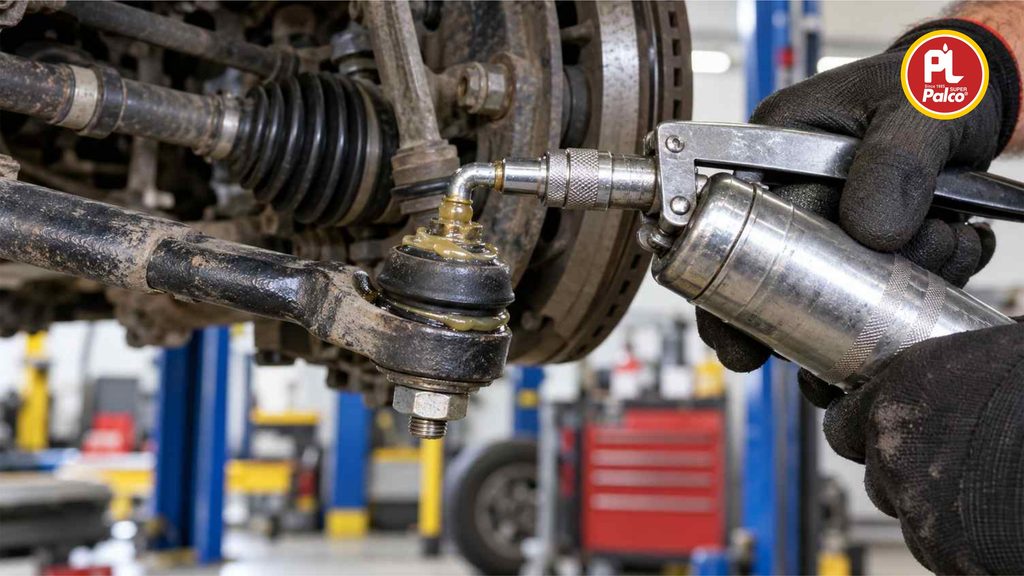
- Chassis and Suspension Linkages: Both AP 2 and AP 3 may be suitable for chassis components such as ball joints, kingpins, and steering tie rods, depending on the equipment manufacturer’s specifications and operating conditions.
- Water Pumps and Generators: Older-style automotive water pumps and industrial plain bearings benefit greatly from the sealing properties of a quality all-purpose grease, keeping moisture out and maintaining smooth rotational efficiency.
Implementing a Professional Maintenance Protocol
Even a properly formulated lubricant can perform poorly if it is incorrectly selected, contaminated, over-applied, or improperly maintained. Proper lubrication practices are therefore essential for reliable equipment performance.
To maximize the effectiveness of your AP grease, technicians must adopt strict workshop protocols. Before attaching a pneumatic grease gun to any vehicle, the exterior of the fitting must be wiped completely clean with a shop towel. Failing to clean the fitting guarantees that the mechanic will inject abrasive road sand directly into the delicate joint.
Furthermore, technicians should take care to avoid cross-contamination when applying grease. Mixing different grease formulations can affect consistency and performance, particularly when the thickeners or base oils are incompatible. Before repacking wheel bearings, old grease and contaminants should be removed thoroughly using an appropriate cleaning method, and the components should be inspected before fresh grease is applied.
Using the correct grease and following proper application practices can help support reliable lubrication and component performance. By understanding the differences between AP 2 and AP 3 grease and following proper maintenance practices, mechanics can make more informed lubrication choices for different vehicles and equipment.