
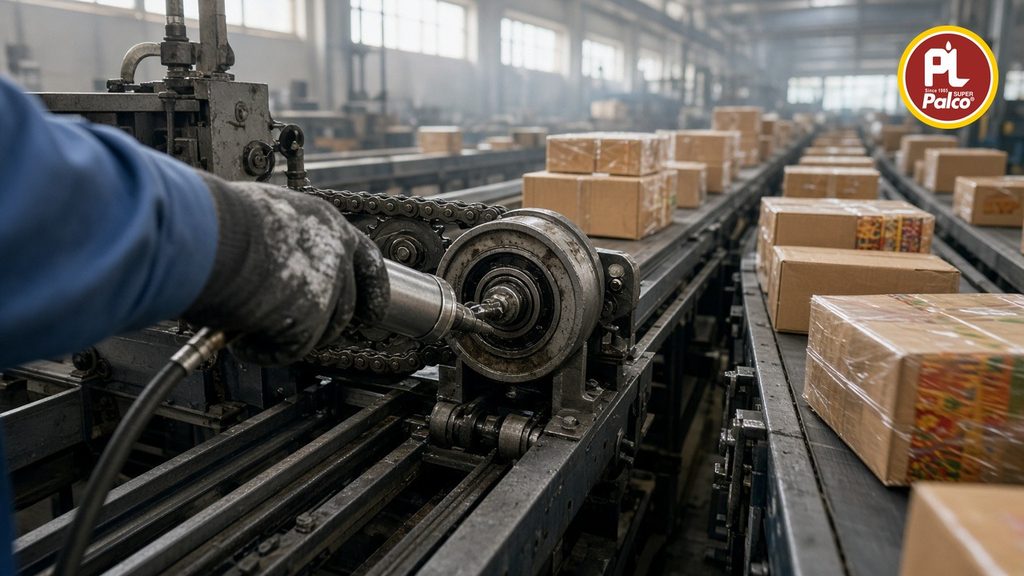
Prepare production lines for festive demand with festive season lubrication maintenance to reduce equipment failures and help prevent costly downtime.
For FMCG, food and beverage, and packaging manufacturers in India, the festive season is the busiest stretch of the year. From the run-up to Diwali through the wedding season and into year-end, plants push for higher output: sweets and snacks, beverages, personal care products, gift packs and the cartons, films and labels that carry them. Lines that normally run two shifts move to three. Planned maintenance windows shrink or disappear. Every hour of production becomes more valuable.
Effective festive season lubrication maintenance helps manufacturers prepare equipment for longer operating hours and higher production demand.
This is also when equipment is under the most stress. Bearings, gearboxes, conveyors, chains, and hydraulic systems run longer, hotter, and harder than at any other point in the year. Many of the failures that stop a line during peak season trace back to a single root cause: lubrication that was missed, wrong, degraded, or contaminated. The good news is that lubrication is also among the most controllable factors in plant reliability. A disciplined approach before and during the festive peak can make the difference between meeting dispatch commitments and missing them.
Why Downtime Costs More in Peak Season
Unplanned downtime is expensive at any time, but its cost rises sharply when demand is at its highest. In a normal month, lost output can often be recovered over a weekend or an extra shift. During the festive season, there is usually no spare capacity left to recover it. A stoppage on a filling, wrapping, or cartoning line can mean missed truck slots, short-shipped orders to distributors and retailers, and products that arrive after the festival they were made for.
Seasonal products have a narrow selling window, retail partners expect fill rates to hold precisely when volumes peak, and emergency repairs and urgent spares cost more when suppliers are also stretched. Rushed repairs also carry a higher risk of repeat failures. Food and beverage plants face an added layer of risk: a breakdown that leads to a leak or contamination event can result in product holds, rework, or disposal.
For these reasons, the weeks before the peak are the time to invest in reliability, not the weeks during it.
Common Lubrication-Related Failures on Production Lines
Understanding where failures typically start helps maintenance teams focus their effort where it matters most.
Bearings
Rolling-element bearings in motors, fans, pumps, conveyor pulleys, and packaging machines are among the most frequent failure points. Under-greasing leads to metal-to-metal contact and wear; over-greasing causes churning, heat build-up, and seal damage. Contamination from dust, product residue or washdown water is a major contributor to premature bearing failure. Early warning signs include rising temperature, increased noise and vibration, and discoloured or hardened grease at the purge point.
Gearboxes
Gear reducers on conveyors, mixers, extruders and palletisers depend on the correct oil type, viscosity and level. Extended running hours accelerate oil oxidation, and higher loads increase the risk of scuffing and pitting on gear teeth. Leaking seals, low oil levels, water ingress from washdown and the use of an incorrect grade are common causes of gearbox distress.
Conveyors
Conveyors connect every stage of a packaging or processing line, so a single conveyor failure can stop an entire line. Idlers, rollers, take-up assemblies, and drive pulleys all need regular attention. Dry or seized rollers increase belt drag and motor load, while excess lubricant on or near belts can attract dirt and create product-contact risks.
Chains
Drive chains and conveyor chains wear at the pins and bushings when lubricant fails to penetrate the joints. The result is chain elongation, poor sprocket engagement, jerky motion, and eventually breakage. Chains in ovens, dryers, shrink tunnels and other hot zones are particularly vulnerable, because ordinary lubricants can evaporate, carbonise or drip at high temperatures.
Hydraulics
Hydraulic systems on presses, balers, lifting equipment and some packaging machines are sensitive to fluid condition. Contaminated, aerated or overheated hydraulic oil causes sluggish operation, valve sticking, pump wear and leaks. Fluid that is topped up with the wrong product or from a dirty container can damage components that are expensive and slow to replace.
Festive Season Lubrication Maintenance Checklist
A short, structured inspection before the peak catches most avoidable problems. The following checklist can be adapted to individual plants:
- Review the lubrication schedule and confirm that every point due in the coming weeks has been completed or scheduled.
- Regrease critical bearings with the correct grease and quantity, and check that grease fittings are clean, accessible, and not blocked.
- Check oil levels, condition, and leaks on all gearboxes; change oil that is dark, milky, sludgy, or past its service interval.
- Clean, inspect, and lubricate drive and conveyor chains; measure elongation, and replace worn chains and sprockets as a set when needed.
- Inspect conveyor rollers, idlers, racks, and pulleys for noise, heat, or seizure.
- Sample or inspect hydraulic fluid; check filters, breathers, hoses and reservoir levels.
- Verify that food-grade lubricants are in use wherever incidental food contact is possible and that this is documented.
- Audit the lubricant store for labelling, sealing, cleanliness and stock levels.
- Confirm that critical spares and the correct lubricants are on hand for the full peak period.
- Brief every shift on the lubrication schedule and the escalation process for abnormal noise, heat or leaks.
Food-Grade NSF H1 Lubricants Where Incidental Contact Is Possible
In food, beverage and some packaging operations, lubricants used on equipment above or near the product zone may come into incidental contact with food, ingredients or primary packaging. In these areas, lubricants registered as NSF H1 are intended for use where incidental food contact may occur. They are formulated with ingredients considered acceptable for this purpose, within defined limits.
Peak season is when the risk of a mix-up is highest. Temporary staff, extra shifts and urgent top-ups can lead to a general-purpose lubricant being used on a food-zone machine. Plants can reduce this risk by maintaining a clear list of food-zone lubrication points, colour-coding or tagging those points, storing food-grade lubricants separately with dedicated dispensing equipment, and keeping certificates and registration details readily available for audits. Where a plant aims to simplify, standardising on food-grade products across a whole line removes the possibility of a wrong product being used. Manufacturers such as Palco offer NSF H1 registered food-grade lubricants, which makes it practical to apply one standard across food-zone equipment.
High-Temperature and Chain Lubrication
Ovens, baking and roasting lines, fryers, shrink-wrap tunnels, sealing stations and dryers expose bearings and chains to sustained heat. In these conditions, conventional greases and oils can soften, run out, oxidise or leave hard carbon deposits that increase wear and friction.
High-temperature greases and chain lubricants, such as those in Palco’s industrial range, are formulated to resist these effects. Good practice includes selecting a product rated for the actual operating temperature, applying it so that it reaches the chain’s pins and bushings rather than only coating the outer plates, and lubricating at the frequency that matches heat, speed, and load. Automatic or drip lubrication can help maintain consistency on chains that run continuously. Where hot-zone equipment is also in a food area, the lubricant should be suitable for the temperature and food-grade where required. Removing old carbonised deposits before the season begins also allows fresh lubricant to work effectively.
Storage, Handling and Contamination Control
Even the right lubricant causes failures if dust, moisture, product residue or another product contaminates it before it reaches the machine.
Lubricants should be stored indoors in a clean, dry, covered area, with containers kept closed and every drum, pail and grease gun clearly labelled. Dedicated, clean transfer equipment for each product, wiping fittings before application, and breathers and filters on gearboxes and hydraulic reservoirs keep contamination out. Stock should be rotated first-in, first-out, and in food plants, food-grade products should be stored and dispensed separately.
Shift-Wise Lubrication Schedules
When plants move to extended or three-shift operation, lubrication tasks that were done once a day may need to be done once per shift, and responsibility can easily fall between shifts. A shift-wise schedule makes ownership clear.
An effective schedule assigns each lubrication point to a specific shift, states the product, quantity, and method, and includes a simple sign-off. Routine visual checks, such as oil levels, leaks, chain condition, and unusual noise, can be built into each shift’s start-up and handover routine. High-frequency tasks on hot or fast-running equipment can be scheduled at natural breaks such as changeovers. A handover log helps the next shift understand what was done, what was found, and what still needs attention. Reviewing completion daily keeps the plan on track.
Keeping Critical Spares and Lubricants Stocked
Peak season is a poor time to discover that a critical bearing, chain, seal, or the correct grade of lubricant is out of stock. Transport and supplier lead times often lengthen during the festive period.
Maintenance teams can identify the components whose failure would stop a line and confirm that spares are available on site. Bearings for critical motors and pulleys, chains and sprockets, gearbox seals, hydraulic hoses and filters are common priorities. Lubricant consumption is likely to be higher with extra running hours, so stocking enough of each required grade for the entire peak period, with a safety margin, avoids last-minute substitutions with unsuitable products. Placing orders early with lubricant suppliers, whether Palco or another established manufacturer, helps secure timely delivery.
Conclusion: Prepare Now, Run Through the Peak
Festive-season reliability is decided before the first extra shift starts. Plants that complete overdue lubrication, confirm the right product at every point, protect lubricants from contamination, give each shift clear ownership, and stock critical spares go into peak demand with far fewer surprises. The few hours spent on these checks now are small compared with the cost of a stopped line in the busiest week of the year. Teams reviewing lubricant selection for food-zone, high-temperature, or chain applications can find technical guidance at palco.co.in.