Explore lithium grease applications, benefits, and uses for automotive and industrial equipment. Please reach out today to get the right PALCO solution for your needs.
In the complex world of mechanical engineering and automotive maintenance, the pursuit of efficiency always comes down to managing friction. Every moving component, from a high-speed electric motor to the universal joint on a commercial driveshaft, relies on a microscopic barrier of lubrication to survive. While highly specialized greases exist for extreme niche environments, the vast majority of global industries rely on a single, highly versatile chemical formulation to keep their operations running smoothly. That formulation is lithium-based grease.
For decades, maintenance professionals have sought a “multi-purpose” solution, a single product capable of handling moderate heat, resisting mechanical breakdown, and providing a reliable seal against dust. The development of lithium soap thickeners revolutionized workshop inventories by fulfilling all these requirements simultaneously. Today, trusting a meticulously engineered lithium formulation from an established manufacturer like Paras Lubricants Limited ensures that both automotive and industrial machinery operate with maximum reliability.
The Evolution of the Grease Matrix
To appreciate the dominance of lithium grease, one must understand how lubricating greases actually function. Grease is not simply a highly viscous oil. It is a carefully balanced mixture of a liquid base oil, a thickening agent, and specific performance additives. The thickener acts very much like a microscopic sponge. Its primary job is to hold the liquid oil in place until mechanical pressure or heat forces the oil out to lubricate the moving metal surfaces. Once the pressure stops, the thickener matrix absorbs the oil back into its structure.
Before the widespread adoption of lithium, workshops had to rely on sodium-based or calcium-based greases. Sodium greases offered decent high-temperature performance but were highly susceptible to dissolving in water. Calcium greases provided excellent water resistance but would melt entirely at relatively low temperatures. This forced mechanics to stock multiple types of grease and risk catastrophic component failure if the wrong type was applied.
The introduction of the lithium soap thickener changed the entire landscape of preventive maintenance. By reacting lithium hydroxide with specific fatty acids, chemists created a thickener that offered the best of both worlds. It delivered a moderately high drop point alongside respectable water resistance, effectively crowning it the ultimate multi-purpose workshop lubricant.
Core Chemical and Physical Advantages
The enduring popularity of lithium base grease is driven by a highly specific set of physical characteristics that make it incredibly forgiving in a wide variety of mechanical environments.
Exceptional Shear Stability: When a bearing rotates at high speeds, the grease packed inside is subjected to severe mechanical shearing. Inferior thickeners will be physically chopped up by this movement, causing the grease to lose its structural integrity and leak out of the housing as a liquid. Premium lithium formulations are renowned for their mechanical stability. The chemical sponge refuses to break down under continuous vibration and rapid rotation, ensuring the base oil remains suspended exactly where it is needed over extended service intervals.
Thermal Endurance and Drop Point: Friction inevitably generates heat. As a bearing or gear set operates, the ambient temperature inside the metal housing rises significantly. Lithium base greases boast a high drop point, which is the specific temperature threshold where the thickener fails, and the grease becomes a liquid. While not intended for the extreme heat of heavy commercial braking systems, standard lithium greases comfortably handle the operational temperatures of everyday automotive and industrial equipment without melting or running out of the seals.
Oxidation Resistance: Over time, exposure to oxygen causes lubricants to degrade, darken, and harden into a useless, varnish-like substance. High-quality lithium greases are fortified with advanced oxidation inhibitors. This chemical fortification prevents the base oil from breaking down during long periods of storage or extended use, maximizing the lifespan of the mechanical component.
Lithium Grease Applications: Automotive & Industrial Uses
Lithium grease applications cover a wide range of automotive and industrial equipment, making this versatile lubricant a practical choice for many maintenance requirements. By standardizing a single, high-quality product, facility managers and garage owners can streamline their inventory and reduce the risk of cross-contamination that occurs when incompatible greases are accidentally mixed.
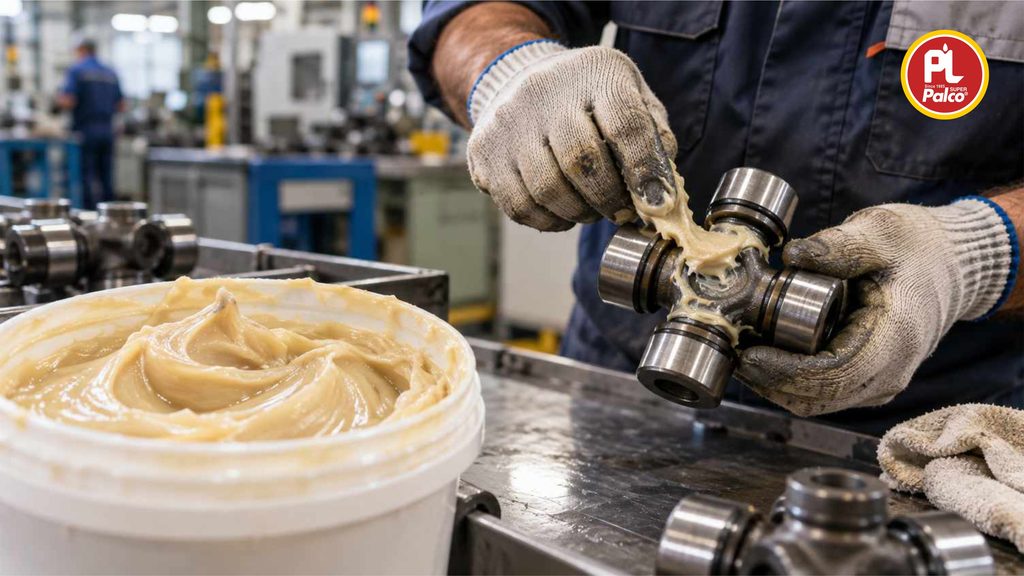
- Automotive Drivetrains: It is the industry standard for lubricating universal joints, constant velocity joints, and sliding chassis mechanisms on passenger cars and light commercial vehicles. It provides a smooth, dependable barrier that absorbs everyday road vibrations.
- Electric Motors: Industrial electric motors require a lubricant that can handle high-speed rotation without causing excessive drag. The smooth, buttery texture of a lithium formulation minimizes internal friction, allowing motors to run efficiently without overheating.
- General Manufacturing: Lithium grease is used on conveyor rollers, fan bearings, and sliding tracks. Industrial greases are available for specific equipment and operating requirements.
- Agricultural Equipment: While specialized waterproof greases are needed for submerged pumps, standard lithium grease is perfect for the enclosed bearings, linkages, and pivot points found throughout combine harvesters and tractors.
Best Practices for Application and Maintenance
The performance of even the most sophisticated Palco formulation depends entirely on the cleanliness and accuracy of its application. Mechanical failure is rarely caused by the grease itself; it is almost always caused by poor maintenance protocols.
- Eliminate Cross-Contamination: Never mix a lithium base grease with an existing calcium, sodium, or barium grease. Different thickeners often react poorly with one another. When incompatible greases mix, the chemical matrix collapses, releasing all the base oil and leaving the bearing completely dry.
- Complete Flushing: When servicing a bearing or a universal joint, take the time to completely clean out the old lubricant. If dealing with an open Zerk fitting, pump the new lithium grease in slowly until all the dark, contaminated grease is pushed out of the relief ports.
- Prevent Seal Ruptures: A common mistake in automotive garages is over-pressurizing a grease fitting. Using a high-pressure pneumatic grease gun can easily blow out the delicate rubber dust boots surrounding a joint. Once the boot is torn, dirt and water have free access to the bare metal. Always pump slowly and watch for the rubber seal to swell just slightly.
- Maintain Clean Equipment: Always wipe the tip of the grease gun and the exterior of the Zerk fitting with a clean shop towel before making a connection. Failing to do so simply injects abrasive exterior dirt straight into the heart of the precision bearing.
Choosing a dedicated PALCO lithium grease is a commitment to long-term mechanical reliability. By leveraging the expertise of established manufacturers and adhering to strict application protocols, maintenance professionals can ensure their equipment operates at peak efficiency, minimizing costly downtime and extending the lifespan of vital machinery.