
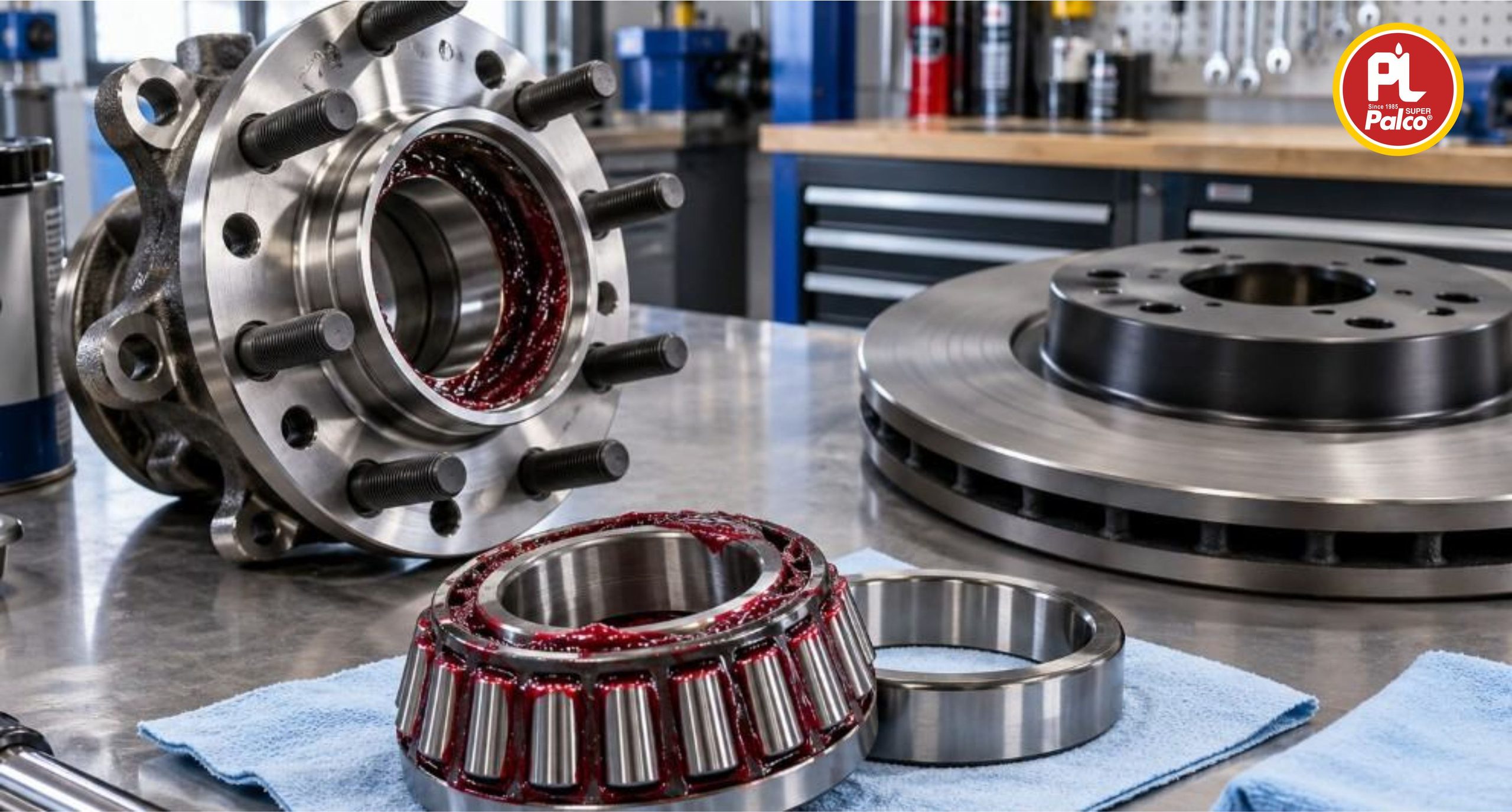
PALCO Wheel Bearing Grease provides reliable lubrication and protection for automotive wheel bearings. Enquire now for quality supply.
When it comes to automotive safety and performance, drivers and fleet managers rightfully prioritise brakes and tyres. Yet, tucked away inside the hub assembly is a small but absolutely critical component that keeps those wheels turning safely. The wheel bearing. Without a fully functioning wheel bearing, the wheels of a passenger car, commercial truck, or agricultural tractor would grind to a halt. Protecting this vital mechanical component requires more than just routine maintenance. It demands a highly specialised boundary lubricant capable of withstanding extreme thermal and physical stress.
For mechanics and maintenance professionals, selecting the correct wheel bearing grease is one of the most important decisions in the garage. Applying an inferior product leads to rapid mechanical failure, compromised safety, and expensive repairs. By understanding the unique chemistry and physical demands of wheel hubs, automotive professionals can ensure their vehicles remain on the road longer. Trusting an established manufacturer like Paras Lubricants Limited provides the reliability needed to handle the harshest driving conditions.
The Anatomy of Wheel Bearing Stress
To understand why a dedicated wheel bearing grease is necessary, one must first look at the extreme environment in which these bearings operate. Unlike suspension joints that articulate slowly over bumps, wheel bearings endure continuous, high-speed rotation. Every time a vehicle accelerates onto a highway, the rollers inside the bearing spin thousands of times per minute.
This rapid rotation generates an immense amount of thermal energy. Friction is the natural enemy of any moving metal part, and in a wheel hub, that friction translates directly into severe heat. If a vehicle is carrying a heavy payload or towing a trailer, the physical load placed on the bearing increases exponentially, which in turn drives the operating temperature even higher.
Furthermore, wheel bearings are subjected to constant shock loading. Every pothole, speed bump, and uneven stretch of road sends kinetic energy directly through the tyre and into the hub assembly. The grease packed inside the bearing is the only thing standing between the hardened steel rollers and the metal race. If the boundary layer of lubrication fails, the metal surfaces will make direct contact. This triggers a destructive chain reaction of scoring, pitting, and catastrophic metal fatigue.
Why Standard Greases Fail in Wheel Hubs
A common and often expensive mistake made in both DIY garages and professional workshops is utilising a standard, general-purpose grease for wheel bearings. While multi-purpose lubricants are perfectly adequate for slow-moving chassis components, they are chemically ill-equipped to survive the extreme conditions found inside a wheel hub.
The primary point of failure for standard greases is their drop point. The drop point is the specific temperature at which the grease structure breaks down and transitions from a semi-solid gel into a liquid. Because wheel bearings generate massive amounts of heat, especially during heavy braking, the temperature inside the hub can easily exceed the drop point of a basic grease. When this happens, the grease melts and leaks out of the bearing cavity.
Once the grease liquefies and escapes, the bearing is left completely dry. Operating a dry wheel bearing causes friction to spike dramatically. The driver will typically hear a loud roaring or grinding noise coming from the wheel well. If ignored, the bearing will eventually seize entirely, potentially locking up the wheel while the vehicle is in motion.
The Formulation of Premium Wheel Bearing Grease
To combat the intense heat and severe physical loads, premium wheel bearing greases are engineered with highly specific chemical structures. Manufacturers like Palco formulate these lubricants to provide uncompromising stability under extreme conditions.
The foundation of an effective wheel bearing grease lies in its thickening agent. Advanced thickeners, such as lithium complexes or specialised sodium bases, are utilised to create a highly stable matrix. This chemical structure provides an exceptionally high drop point, ensuring the grease remains in a semi-solid state even when subjected to the intense thermal loads of highway driving and heavy braking.
Beyond thermal stability, high-quality wheel bearing grease must possess aggressive shear stability. As the bearing rollers spin, they subject the grease to continuous mechanical shearing forces. A robust formulation will resist being chopped up and thinned out by this constant motion, maintaining its protective film thickness over thousands of kilometres.
These premium greases are also heavily fortified with specialised additive packages. Extreme pressure additives create a sacrificial chemical film on the metal surfaces, preventing metal-to-metal welding during severe shock loads. Anti-wear agents further reduce friction, while rust inhibitors protect the sensitive steel components from moisture that may bypass the hub seals during heavy rain or flooded road conditions.
Best Practices for Hub Maintenance and Repacking
Even the most advanced wheel bearing grease cannot perform effectively if it is applied incorrectly. Proper maintenance protocols are essential for maximising the lifespan of the hub assembly. Whether you are servicing a daily commuter or a heavy-duty commercial truck, the repacking process must be handled with precision.
- Complete Contaminant Removal: Before introducing fresh grease, the entire bearing assembly and hub must be thoroughly cleaned. All traces of the old, degraded grease must be removed using a dedicated parts cleaner. Mixing different types of grease can cause a chemical incompatibility that breaks down the thickener, leading to immediate lubrication failure.
- Thorough Inspection: Once the bearing is perfectly clean and dry, it must be inspected under a bright light. Mechanics should look for any signs of heat discolouration, pitting on the rollers, or scoring on the race. If any physical damage is detected, the bearing must be replaced entirely.
- The Repacking Process: Fresh grease must be forced deeply into the bearing cage, ensuring every gap between the rollers is completely filled. This can be done by hand using the traditional palm method or by utilising a dedicated bearing packer tool for maximum efficiency.
- Proper Hub Filling: A critical error during installation is overpacking the hub cavity. While the bearing itself must be fully saturated with grease, the surrounding hub should only be partially filled. Overpacking leaves no room for the grease to expand as it heats up. This internal pressure can blow out the hub seals, allowing moisture and dirt to enter the assembly.
The Investment in Long-Term Reliability
Routine wheel bearing maintenance is not an area where vehicle owners can afford to cut corners. The safety of the driver, the passengers, and the surrounding vehicles relies entirely on the structural integrity of the hub assembly. By moving away from cheap, standard lubricants and standardising a specialised wheel bearing grease, mechanics can significantly enhance the safety and reliability of the vehicles they service.
Selecting a product engineered by Paras Lubricants Limited means choosing decades of manufacturing expertise. Their dedication to producing high-performance automotive greases ensures that fleet operators and individual drivers have access to lubricants that can endure the toughest conditions. Investing in a premium wheel bearing grease is a direct investment in automotive longevity, providing peace of mind for every journey.
PALCO Wheel Bearing Grease provides reliable lubrication and protection for automotive wheel bearings. Please contact us now for high-quality supplies.