PALCO calcium chassis grease provides water-resistant lubrication for automotive chassis, suspension, and steering parts. Enquire now.
When automotive enthusiasts and maintenance professionals discuss vehicle longevity, the conversation almost universally defaults to the engine bay. We obsess over synthetic motor oils, transmission fluid change intervals, and high-performance coolant mixtures. Yet the true physical foundation of any heavy-duty truck, passenger vehicle, or agricultural tractor lies entirely exposed to the world below. The undercarriage houses a complex network of articulating joints that dictate steering precision, load-bearing capacity, and overall safety. Protecting this exposed mechanical network requires a deep understanding of boundary lubrication and the highly specific chemical properties of calcium chassis grease.
The structural integrity of a vehicle relies heavily on components like ball joints, tie rod ends, kingpins, and U-joints. Unlike internal engine parts that are sealed away in a sterile environment and continuously bathed in a pressurised flow of warm oil, suspension joints operate in a harsh open-air environment. They are constantly subjected to extreme boundary lubrication conditions. This means there is no continuous flow of fluid to separate the metal surfaces. Instead, these components rely entirely on a stationary and protective barrier of grease to prevent catastrophic metal-to-metal contact.
The Constant Mechanical Threat: Pound Out and Shock Loading
Understanding the specific threats to these components is the first step in proper automotive and fleet maintenance. Every kilometre a vehicle travels exposes its undercarriage to abrasive road dust, flying gravel, deep mud, and standing water. When a commercial vehicle hits a pothole or navigates a rough agricultural field, the suspension system absorbs a massive amount of kinetic energy. This creates an intense shock load on the joints.
If the grease packed inside those joints is thin, chemically unstable, or poorly formulated for the environment, the extreme pressure will physically squeeze the lubricant right out of the fitting. In the heavy machinery and commercial transport industries, this highly destructive phenomenon is known as pound-out.
Once pound-out occurs, the protective boundary layer vanishes. The bare metal surfaces of the ball joint or tie rod begin to grind directly against each other. This friction generates immense heat and leads to scoring, galling, and a rapid widening of the mechanical tolerances. The driver will typically first notice this degradation as stiff steering, wandering alignment, or unusual clunking noises over bumps. Eventually, the weakened joint will fail, resulting in highly dangerous driving conditions and emergency repair bills.
Water Washout and the Mechanics of Rust
Equally destructive to undercarriage components is the threat of moisture. Vehicles operating in monsoon regions, muddy construction sites, or off-road agricultural zones are constantly battling water ingress.
Many DIY mechanics and even professional workshops make the critical error of applying standard multi-purpose greases to the chassis. While these greases are excellent for sealed, high-temperature environments like wheel bearings, they often lack the chemical resilience required to survive road spray. When a standard grease is bombarded by deep puddles, the water rapidly dissolves the lubricant in a process called water washout.
Once the grease washes away, it leaves the bare metal completely exposed to oxygen and water. This triggers immediate flash rusting. Rust acts as a highly abrasive contaminant. It turns whatever small amount of grease is left into a grinding paste that destroys the component from the inside out.
Recognising the signs of failing chassis lubrication can save thousands in fleet maintenance:
- Stiff or Unpredictable Steering: A lack of lubrication in the kingpins or tie rod ends creates severe friction, making the steering wheel difficult to turn.
- Squeaking and Creaking: Audible groans over speed bumps are the classic sound of dry metal rubbing against dry metal.
- Uneven Tire Wear: As ball joints wear down from internal friction, the vehicle loses its alignment, causing tyres to scrub aggressively against the pavement.
- Ruptured Dust Boots: A cracked or torn rubber boot around a joint means water has already entered, and the grease has likely been contaminated.
The Calcium Advantage in Heavy-Duty Applications
To combat the dual threats of pound-out and water washout, mechanics must select a grease engineered specifically for tenacity and structural stability. This is where the chemistry of the grease thickener becomes critical. Grease is essentially a base oil held together by a thickening agent, functioning much like a sponge holding water.
For the exposed suspension and steering linkages, the gold standard is a premium calcium-based grease. Calcium soap thickeners possess an inherently hydrophobic molecular structure. This means they actively repel water rather than emulsifying with it. A high-quality calcium chassis grease will cling tenaciously to the metal surfaces and create a completely waterproof seal. This locks out moisture, prevents rust, and refuses to wash away even when the vehicle is submerged in deep mud or driven through torrential rain.
For maintenance teams looking for a highly reliable chemical solution, Paras Lubricants Limited has engineered specific formulations that highlight this specialised chemistry. With decades of expertise in industrial manufacturing, they produce a calcium chassis grease that leverages a robust calcium base to deliver unmatched water resistance alongside aggressive tackiness.
The tackiness of a chassis grease is its most vital physical trait. When you stretch a highly adhesive grease between your fingers, it forms stringy and sticky peaks. This adhesive quality is exactly what allows the lubricant to cling tightly to a kingpin or ball joint. The aggressive adhesion ensures the lubricant stays exactly where it was applied, maintaining the critical boundary layer and absorbing heavy shock loads without being displaced.
Best Practices for Application and Maintenance
Beyond its physical structure, proper application is absolutely essential for maximising the lifespan of suspension parts. Pumping the highest quality grease into a joint is useless if the fitting itself is contaminated. Workshop technicians and agricultural operators must adopt strict greasing protocols to ensure the integrity of the lubricant.
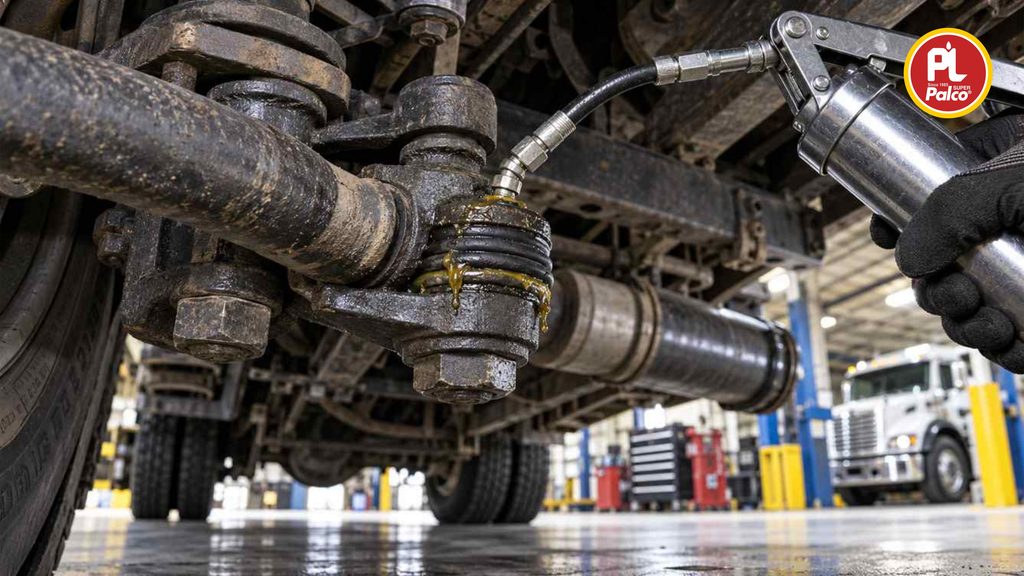
- Strict Surface Preparation: Before attaching a grease gun, the exterior of the Zerk fitting must be wiped completely clean with a dedicated degreaser or shop towel. Failing to clean the fitting means the pressurised gun will inject abrasive road sand directly into the delicate joint.
- Controlled Pressurisation: The grease should be pumped in slowly and steadily. For components with rubber dust boots, the mechanic must watch the boot closely. The goal is to apply just enough grease to make the boot swell slightly.
- Avoiding Over-Packing: Over-pressurising the fitting can easily rupture the rubber seal. A broken seal immediately allows water and dirt to flood the component, negating the purpose of the grease entirely.
- Flushing Open Fittings: For older-style open fittings, the fresh grease should be pumped until the old and darkened grease begins to purge out of the edges. This ensures the joint has been completely flushed with fresh lubricant.
The versatility of a well-formulated calcium grease makes it indispensable across multiple sectors. In the commercial transport industry, fleet managers standardise this type of lubricant to keep their heavy trucks and buses safely on the road. In the agricultural sector, farmers rely on these resilient greases to protect the exposed pivot points, chain drives, and linkages of their tractors and harvesters. Equipment operating in dry and dusty fields requires a grease that seals out grit, while machinery operating in wet and muddy conditions demands absolute water resistance.
Selecting the right undercarriage lubricant is a direct investment in safety and operational efficiency. Moving away from generic multipurpose tubs and standardising on a specialised, highly adhesive calcium-based chassis grease formulation ensures that any vehicle can withstand the harshest environments. Prioritising a dedicated chassis grease is one of the smartest mechanical decisions a modern workshop can make.