
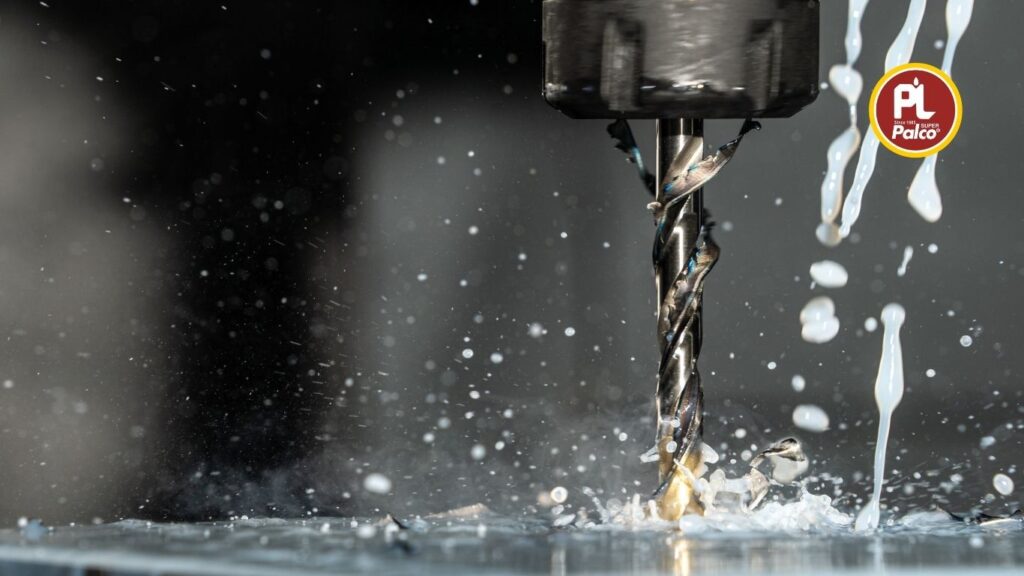
Synthetic cutting fluids help reduce heat, improve machining accuracy, extend tool life, and support cleaner, more efficient metalworking operations.
There is a moment on every shop floor that nobody photographs. The spindle is running, the tool is engaged, and somewhere in the narrow gap between a carbide edge and a piece of steel, a decision made months earlier in a purchasing office is quietly being tested. Not the machine tool decision. Not the insert decision. The fluid decision, the one that was probably made on a comparison of rates per litre, by someone who had four other things to close that afternoon.
I have spent a long time in and around plants, and I have come to believe that synthetic cutting fluids are among the most consequential purchases in a machining operation, yet they are often treated as the least consequential.
Why Synthetic Cutting Fluids Are More Than Just Coolants
We call them coolants. It is a habit of language that has cost the industry more than we realise, because it describes one of five things the fluid actually does, and arguably not the most important one.
Synthetic cutting fluids do far more than cool. They lubricate the shear zone, reducing cutting energy and friction while improving machining efficiency. They flush chips away to prevent recutting, protect both the workpiece and machine from corrosion after machining, and resist bacterial growth that can shorten sump life, affect surface finish, and create an unhealthy working environment.
Call that a coolant and you have already framed it as a commodity. Commodities get bought on price. Systems get bought on outcome.
What Makes Synthetic Cutting Fluids Intelligent
The word is used loosely at the moment, and I want to be precise about it, because the industry does not need another buzzword. It needs a better default.
An intelligent fluid is not one that has sensors in it. It is one that has been designed to behave predictably under conditions it will actually meet, and selected against the specific work it will be asked to do.
Consider what modern synthetic cutting fluids are really designed to do. They contain no mineral oil, so they are not fighting their own base to remain stable. They form a clear solution, allowing operators to see the cut more clearly—a small advantage that turns out not to be small at all. They maintain an alkaline character that protects ferrous surfaces without requiring a separate rust-preventive step.
They also include bactericidal and fungicidal protection, extending sump life and reducing odour complaints. Finally, they resist foaming even under the pressures and flow rates demanded by today’s high-speed machining operations.
These characteristics explain why synthetic cutting fluids outperform conventional coolants in many precision machining applications.
Each of those is a design decision. Together they are the difference between a fluid that survives the process and a fluid that supports it.
There is a further layer of intelligence that has nothing to do with chemistry: matching the fluid to the operation. A grinding application on ferrous alloys does not want the same fluid as a broaching operation, and neither wants what a non-ferrous job wants. A synthetic engineered for grinding will do beautiful work on grinding and cause real problems where it does not belong. The intelligence, in other words, is partly in the drum and partly in the decision to reach for that drum rather than another one.
The True Cost of Synthetic Cutting Fluids
Here is where I will be direct, because it is the point of this piece.
The cost of synthetic cutting fluids is not their purchase price. Purchase price is simply the smallest and most visible component of their total cost, which is precisely why it dominates the conversation.
The real cost of synthetic cutting fluids lies in places that never appear on the purchase order. It is reflected in how often tools need replacing, how many components require rework or refinishing, how frequently the sump must be dumped, cleaned, and recharged, and the cost of treating and disposing of used fluid.
It also appears in unplanned machine downtime, corrosion on parts awaiting the next operation, dermatitis-related absenteeism, and tramp oil that feeds bacterial growth, shortening fluid life and reducing overall machining efficiency. A plant that optimises the litre price and ignores those lines is not saving money. It is relocating the expense to a budget where nobody is looking for it.
Once you look at the whole picture, a synthetic cutting fluid that costs more per drum often costs less per component. That is not a marketing claim; it is arithmetic that many machining operations have simply never been shown. I would extend that point even further: a cutting fluid that is properly monitored and maintained, regardless of its chemistry, will consistently outperform a superior fluid that is neglected.
Concentration drift, tramp oil ingress, biological contamination, and poor top-up discipline are not routine maintenance issues—they are the difference between the performance a fluid was designed to deliver and the performance it actually achieves.
Why Synthetic Cutting Fluids Matter More Than Ever
Indian manufacturing is machining harder materials, holding tighter tolerances, and operating at higher speeds than ever before. Industries such as aerospace, medical devices, EV components, and precision automotive demand consistent quality with minimal variation. In these demanding applications, synthetic cutting fluids have become essential for improving machining performance, extending tool life, maintaining superior surface finishes, and ensuring reliable process stability.
Choosing the right synthetic cutting fluid is no longer a routine purchasing decision—it is a critical factor in improving productivity, precision, and long-term operational efficiency.
At the same time, the workforce conversation has changed. Odour, skin contact and mist are not tolerable line items any more. They are retention problems. A fluid that is non-toxic, non-hazardous in normal use, and stable enough not to turn is not a compliance box. It is part of how a plant keeps good people.
The conversation around disposal is moving in only one direction. Synthetic cutting fluids that remain stable and last longer in the sump reduce disposal frequency, lower operating costs, and minimise environmental impact. Longevity has quietly become as much an environmental advantage as an economic one, helping manufacturers improve both sustainability and overall machining efficiency.
Choosing the Right Synthetic Cutting Fluids for Modern Machining
At PALCO, we have spent four decades formulating synthetic cutting fluids for Indian conditions—Indian water quality, ambient temperatures, duty cycles, and manufacturing environments. That experience has taught us something that is easy to say but difficult to practise: the best synthetic cutting fluid is not necessarily the most advanced one available. It is the one correctly matched to the machining operation, properly maintained, and fully understood by the people using it.
That is the redefinition I would argue for. Not a new chemistry, because the chemistry is already good and continues to improve. What needs to change is the conversation. Stop asking what a synthetic cutting fluid costs. Start asking what it does, what it prevents, and how consistently it continues to deliver those benefits. In the end, the spindle does not care what we paid. It only registers what we chose.