
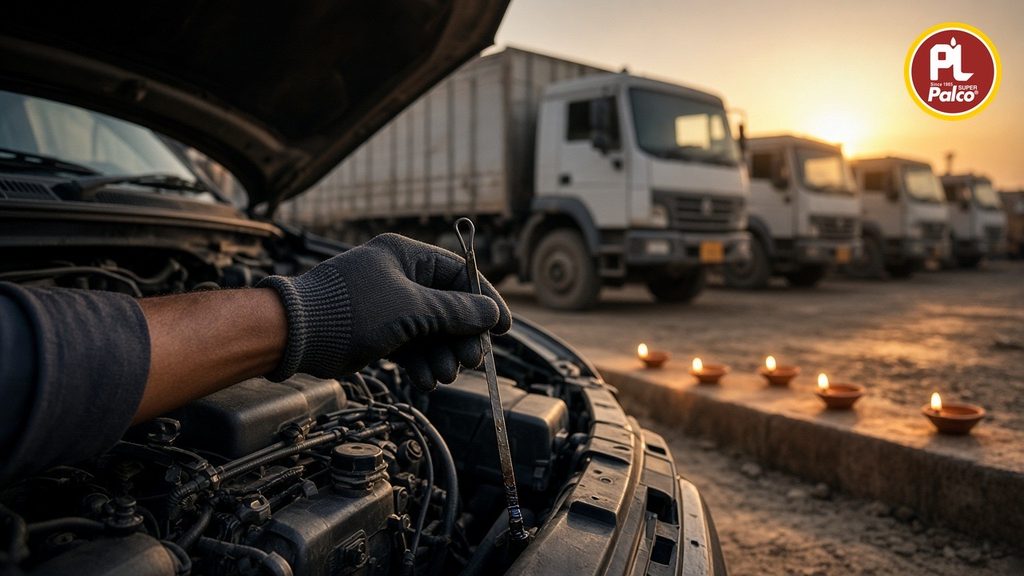
Use PALCO’s Diwali lubrication checklist to prepare fleet vehicles and plant equipment for the festive rush. Please review the guide and reach out with any questions today.
Diwali falls on 8 November this year, and for most transport operators, manufacturers and lubricant dealers, the days leading up to it are among the busiest of the year. Trucks run extended routes to clear festive consignments, plants push output to meet seasonal orders, and dealer counters see a surge in demand for top-ups and service fills. In that rush, lubrication is often the first maintenance task to be postponed and frequently the first cause of an unplanned stop. This Diwali lubrication checklist helps fleet operators and plant teams prepare for the increase in vehicle usage and production.
A breakdown on a highway in the second week of November, or a seized bearing on a packaging line the day before a dispatch deadline, costs far more than a planned oil change. Lost trips, missed delivery windows, emergency repairs and overtime labour quickly outweigh the price of preventive lubrication. The checklist below is designed to help fleet managers, plant maintenance heads, distributors and importers get ahead of these risks, typically with a few hours of focused work per site.
Why the Festive Season Is Hard on Equipment
Several operating conditions change at the same time in late October and early November.
Running hours increase. Vehicles cover more kilometres with shorter rest periods between trips, and plants frequently add shifts or run continuously. Oil that would normally reach its drain interval in six weeks may reach it in three.
Loads increase. Vehicles are loaded closer to their rated capacity, and machines run nearer to their design limits. Higher loads mean higher temperatures and greater stress on oil films and grease in bearings, gears and chassis joints.
The weather shifts. Northern India sees cooler mornings and larger temperature swings, which affect cold starts. Coastal regions continue to face humidity, which encourages moisture contamination and corrosion. Across much of the country, post-monsoon dust finds its way into air intakes, breathers and grease points.
Under these combined conditions, engine oil can thin, oxidise faster or pick up contaminants. Grease that has performed adequately for months can wash out, harden or migrate away from the contact zone exactly when the load peaks. Most of these failures are preventable with timely inspection and the right product.
Diwali Lubrication Checklist for Fleets, Plants and Dealers
For fleets: trucks, buses, LCVs and two-wheeler delivery fleets
- Check drain intervals against actual usage. Review odometer readings and engine hours rather than relying only on the calendar. If a vehicle is due for an oil change within the next 2,000 km, bring it forward before the peak period begins.
- Inspect oil level and condition on every vehicle. Dark, sludgy, or unusually thin oil, or a smell of fuel, indicates that an early change is needed.
- Please confirm the viscosity grade and API classification recommended by the vehicle manufacturer. Choose a matching oil from PALCO’s diesel engine oils for commercial vehicles. Avoid mixing grades during roadside top-ups.
- Replace filters at the same time. A fresh oil fill paired with a clogged filter delivers only part of the benefit.
- Grease every chassis point. Kingpins, spring shackles, propeller shaft joints, wheel bearings, and fifth wheels take the heaviest punishment under festive loads. Purge old grease until fresh grease appears.
- Check coolant level and concentration. Overheating during stop-start urban deliveries is a frequent cause of roadside breakdowns.
- Inspect for leaks. Seepage around sumps, gearboxes and differentials should be addressed before long-haul trips.
- Carry the correct top-up oil in each vehicle. A litre of the right engine oil on board prevents drivers from purchasing an unsuitable product on the road.
- Brief drivers. A two-minute daily check of oil level, coolant and warning lamps catches most problems early.
For plants: manufacturing, processing and packaging units
- Walk through the lubrication schedule. List every lubrication point due in the next three weeks and bring tasks forward wherever possible so that no routine work falls in the middle of peak production.
- Regrease high-load and high-speed bearings. Motors, conveyors, fans, pumps and gearboxes running extra shifts need fresh grease applied in the correct quantity. Over-greasing generates heat in the same way that under-greasing causes wear.
- Match grease to operating conditions. Bearings that run hot, run fast or are exposed to water and washdown require greases formulated for those conditions rather than a general-purpose product.
- Check hydraulic and gear oil levels. Look for leaks, discolouration and foaming. Small leaks tend to grow quickly under continuous duty.
- Review cutting fluids on CNC and machining lines. Check concentration, odour, tramp oil and contamination, all of which affect tool life, surface finish and operator comfort.
- Verify food-grade lubricant use in food and pharmaceutical units. Wherever incidental food contact is possible, only NSF H1 registered lubricants should be used. These should be clearly labelled and stored separately from non-food-grade products.
- Label, seal and organise lubricant stores. Keep containers closed, clean and clearly identified so that contaminated or incorrect products do not reach machines during a busy shift.
- Keep critical spares and lubricants on site. Supply chains slow down over the festival week, so it is prudent to hold sufficient stock until normal deliveries resume.
For dealers, distributors and importers
- Stock fast-moving products early. Popular engine oil grades, two-wheeler oils and multipurpose greases are usually the first to run short during festive weeks.
- Keep small packs visible at the counter. Top-up sizes move quickly when customers are preparing vehicles for travel.
- Plan for the post-Diwali service wave. Many fleets and plants schedule maintenance immediately after the festival, and inventory secured now helps avoid shortages later.
- Account for logistics lead times. Transport capacity tightens around the festival, so orders placed early are more likely to arrive on time.
Matching the Right Palco Product to the Job
Paras Lubricants Limited manufactures a broad portfolio of automotive oils, industrial oils, greases, coolants and food-grade products under the PALCO brand at its plant in Daman. The following categories are most relevant to pre-festive maintenance.
Engine oils for diesel and commercial vehicles. Palco produces engine oils for diesel engines, heavy-duty commercial vehicles and agricultural equipment such as tractors and pumps. According to the company, the range is engineered for engine protection, cleaner operation and longer service life under demanding conditions. Fleet operators should select the grade recommended by the vehicle manufacturer.
Two-wheeler engine oils. For delivery fleets and commuter motorcycles, Palco offers four-stroke engine oils such as FRIX Eco 4T-20W40, which carries API SL and JASO MA2 classifications.
Automotive and industrial greases. Palco greases are designed for both automotive and industrial applications, with an emphasis on load-carrying capability and protection against wear, rust and corrosion. The range includes high-speed bearing greases, synthetic greases for extreme temperatures and high-temperature greases for bearings in hot and wet industrial conditions, which suit the extended-duty demands of the festive period.
Industrial oils and cutting fluids. The industrial range covers general-purpose lubricating oils through to specialised fluids, including soluble cutting oils for CNC machines and cutting fluids for drilling and milling.
Food-grade lubricants. For food processing and related industries, Palco offers NSF H1 registered food-grade products, including PAL Food Guard Grease EPS and PAL Food Guard HT Grease.
Coolants. Palco also manufactures coolants for vehicles, an important part of preventing overheating during high-utilisation periods.
Where there is doubt about the correct grade for a specific engine, gearbox or machine, Palco’s technical team can advise on product selection.
About Paras Lubricants Limited
Paras Lubricants Limited was incorporated in 1985 and markets its products under the PALCO brand. The company is ISO 9001, ISO 14001 and ISO 45001 certified, offers more than 200 products and serves over 2 million customers, with its products trusted in more than 25 countries. Manufacturing takes place at the company’s plant in Daman, while its head office in Delhi and regional office in Mumbai manage marketing, administration and customer support. Palco products are formulated to API and JASO performance classifications and are validated in the company’s in-house R&D laboratory before dispatch.
For dealers and distributors, Palco also offers partnership programmes that include training materials, administrative assistance and technical support.
Preparing Ahead of the Peak
The days before Diwali represent an opportunity to prevent the most common and costly causes of downtime. A structured review of drain intervals, grease points, fluid conditions and lubricant stocks, completed this week, can keep vehicles on the road and production lines running through the busiest period of the year. Fleet operators, plant maintenance teams, dealers, distributors and importers seeking assistance with product selection, festive stock orders or application-specific recommendations can contact Palco at enquiry@palco.co.in or visit palco.co.in.