
Find a reliable bulk food grade grease supplier for food-processing equipment. Explore PALCO Food Guard EPS grease and enquire for bulk supply.
A production line may look spotless after its regular washdown, yet the bearings hidden behind stainless-steel guards face a different reality. Water reaches seals, cleaning agents travel across surfaces, and conveyors restart under load. A press in an animal-feed plant may run for hours with substantial pressure on its moving parts. In both situations, the lubricant needs to do more than make machinery move smoothly.
For food-processing businesses planning bulk purchases, choosing a reliable bulk food grade grease supplier also means checking product specifications, food-safety classification, packaging options, and application suitability.
Food-related operations demand an unusually careful balance. Equipment must stay dependable, cleaning schedules cannot be compromised, and lubricants used where incidental food contact is possible need an appropriate classification. Meanwhile, a bearing does not become less heavily loaded simply because it operates in a food factory. It still needs a protective film between contacting surfaces.
PAL Food Guard Grease EPS from PALCO is formulated for that overlap of operational challenges. It is an NSF H1 registered, NLGI 2 extreme-pressure grease intended for loaded bearings, bushes, and other components in food, beverage, feed, pet food, meat, and sugar-processing equipment. Understanding where it fits starts with understanding what its specifications actually mean.
What Is PAL Food Guard EPS Grease?
PAL Food Guard Grease EPS is a food-grade extreme-pressure lubricant manufactured under the PALCO brand by Paras Lubricants Limited. The product is white, uses a proprietary thickener, and is formulated to resist water, carry demanding loads, maintain mechanical consistency, and help protect metal components from oxidation and corrosion.
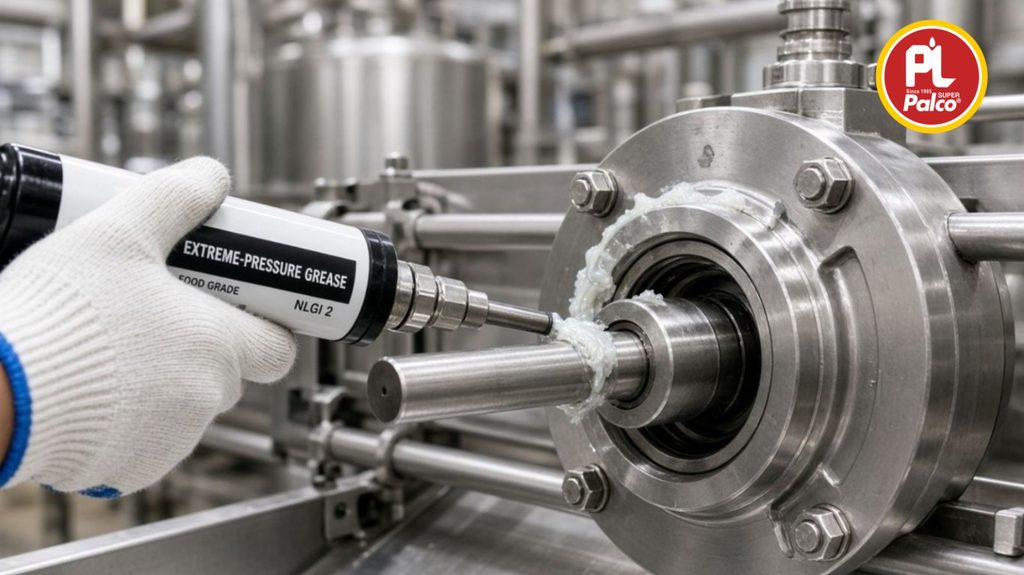
The manufacturer recommends it for pelleting presses, bearings, bushes, rollers, and conveyors, particularly where moisture, washing procedures or continuous operation complicate lubrication. Its published operating temperature range is −42°C to 150°C. This is a wide interval, but an appropriate operating decision still depends on bearing design, speed, load, relubrication, and equipment-maker guidance.
The designation EPS appears in the product name, while extreme-pressure performance is an explicit feature in the published description. Rather than assume the letters establish a separate technical certification, it is more useful to examine the practical performance claims and the listed tests.
Food-Grade Lubrication: What NSF H1 Means
‘Food-grade’ is sometimes understood to mean ‘edible’ or ‘harmless’ under every circumstance. That is not what a lubricant classification communicates. NSF H1 identifies lubricants intended for applications where incidental, technically unavoidable food contact may occur. It is not permission for deliberate addition to food, nor does it remove the need for careful equipment design and contamination control.
PALCO lists PAL Food Guard Grease EPS with NSF H1 registration number 174482 in its food-grade grease range. For procurement teams, this is a useful traceable identifier. Buyers can verify the current registration, match the exact trade name, and review their internal quality requirements before approval.
A good food-safety programme involves more than choosing an H1 product. Maintenance teams also need dedicated and correctly labelled grease equipment, clean storage, appropriate application quantities, sound bearing seals, and records of where each lubricant is used. Food-grade selection is one part of a wider preventive system, not a substitute for that system.
How Extreme-Pressure Grease Protects Heavily Loaded Parts
Imagine two metal surfaces separated by a thin lubricating film. Under ordinary movement, the oil in a grease helps prevent the surfaces from rubbing directly against one another. When a press starts, a conveyor becomes crowded, or a bearing absorbs a sudden load, that protective film can become more difficult to maintain.
Extreme-pressure protection addresses demanding contact conditions. A properly selected EP grease contains chemistry intended to reduce damaging metal-to-metal interaction when load and contact stresses rise. PALCO describes the product as offering high load-carrying capacity and high shock-load absorption. The published page does not provide a four-ball weld-load value for this grease, so it would be misleading to assign a numerical load rating without another verified document.
Load-bearing capacity also is not a guarantee against failure. A worn bearing, poor alignment, improper fit, or inadequate lubricant supply can still produce heat and damage. EP grease supports a sound mechanical system; it cannot repair a defective one.
Why Water Resistance Matters in Food Plants
Water is routine in processing environments. It may be present as spray, condensation, steam deposits, or residue from cleaning. When water reaches a lubricated component, it can carry grease away, change the condition of the lubricant, and leave metal exposed to corrosion.
PAL Food Guard Grease EPS has a published maximum water-washout loss of 5.2% by weight under ASTM D1264. In simple terms, that laboratory method evaluates how much grease is removed by water under specified test conditions. The number supports the manufacturer’s water-resistance claim, but it should not be interpreted as the exact quantity lost in every factory washdown.
Real equipment faces varying spray angles, chemical concentrations, water temperatures, and seal conditions. A laboratory result is a comparison tool, not a complete prediction of performance on a particular machine. In wet service, maintenance staff should inspect the grease that is purged, check for unusual softening, and keep water from entering through damaged seals.
Mechanical and Structural Stability Explained
A grease is not merely thick oil. It consists of a lubricating fluid held within a thickener structure, together with other formulation components. Moving elements continually work this structure as equipment rotates or oscillates. If a grease becomes excessively soft, it may escape from its intended position; if it becomes excessively hard, reliable delivery may become difficult.
PALCO highlights mechanical and structural stability as central features of Food Guard Grease EPS, including the ability to maintain consistency during continuous operation. These qualities matter in busy processing facilities where lubrication points cannot be attended to after every production cycle.
The datasheet reports NLGI grade 2 and a worked penetration of 265–295 after 60 strokes, measured by ASTM D217. NLGI 2 indicates a familiar medium consistency used in many grease-lubricated bearings. Worked penetration measures how far a standard cone enters grease after specified mechanical working; a higher penetration number generally means a softer grease.
This helps explain why grade selection matters. A centralised lubrication network with long narrow lines may require different flow characteristics from an individual bearing lubricated by hand. Confirm pumpability and distribution requirements rather than assuming that all NLGI 2 products behave alike in every system.
Understanding Temperature Limits Without Confusing the Numbers
The published operating temperature range for PAL Food Guard Grease EPS is −42°C to 150°C. This indicates that the manufacturer positions it for low-temperature starting conditions and elevated process temperatures, subject to application suitability.
Its minimum dropping point is 185°C, tested by ASTM D2265. ‘Dropping point’ describes when grease releases a drop during a defined laboratory heating test. It is not a recommended continuous operating temperature and must not be used as the sole basis for equipment selection. The upper operating figure of 150°C is the relevant published limit to discuss with the maintenance team.
At the cold end, low temperature can make some greases more resistant to movement and distribution. Good low-temperature performance may therefore be important in refrigerated process areas, cold-storage handling lines and equipment that starts after extended shutdowns. Whether this product suits a particular refrigerated bearing depends on startup torque, speed and the machinery supplier’s recommendations, not the temperature number alone.
Oxidation, Corrosion and Cleaning Conditions
Heat and exposure to air can gradually oxidise a lubricant. Moisture and reactive residues can contribute to corrosion on metal components. PALCO describes Food Guard Grease EPS as providing anti-oxidation and anti-corrosion protection, as well as resistance to food acids and alkaline conditions.
These features are relevant to equipment that may encounter washdown agents or incidental exposure to process materials. They do not mean that the grease is compatible with every cleaning chemical, every concentration, or prolonged immersion. Sanitation chemicals vary considerably, and compatibility questions should be checked with the equipment manufacturer and lubricant supplier.
The listed copper corrosion result is 1b under ASTM D4048. This is a standardised strip-test classification indicating slight discolouration under the test conditions. It is useful evidence, though not a universal corrosion guarantee for every alloy, seal material, or plant atmosphere.
Key Published Specifications at a Glance
- Appearance: white.
- NLGI consistency grade: 2, according to DIN 51818.
- Worked penetration, 60 strokes: 265–295 (ASTM D217).
- Minimum dropping point: 185°C (ASTM D2265).
- Water washout: 5.2% maximum weight loss (ASTM D1264).
- Copper corrosion: 1b (ASTM D4048).
- Base oil viscosity at 40°C: 220 cSt (ASTM D445).
- Thickener: proprietary; the public specification does not identify its chemistry.
- Published operating temperature interval: −42°C to 150°C.
- NSF H1 registration: 174482, as listed in PALCO’s food-grade product range.
One important distinction concerns base-oil viscosity. The value of 220 cSt at 40°C describes the viscosity of the lubricating fluid within the grease, not the overall consistency of the finished material. NLGI grade and base-oil viscosity answer different questions and should be evaluated together for bearing selection.
Where This Food-Grade EP Grease Is Recommended
Explore PALCO’s food-grade products for lubrication requirements across food-processing and related industries.
Pelleting presses in feed and pet food production
Pelleting presses subject components to continuous pressure, vibration, and sustained operation. PALCO explicitly identifies feed, pet food, and sugar-industry pelleting presses as applications. A suitable EP lubricant can help protect loaded contact points, while the H1 designation addresses the food-related setting where incidental contact is possible.
Food and beverage conveyors
Conveyor bearings and rollers operate throughout processing and packaging areas. Some locations remain relatively dry; others are exposed to rinsing, moisture, and changing ambient temperatures. The combination of an NLGI 2 consistency, water resistance, and corrosion protection makes Food Guard Grease EPS worth assessing for the manufacturer’s recommended conveyor lubrication points.
Meat-processing machinery
Meat-processing facilities often combine frequent cleaning with low-temperature rooms and moving mechanical assemblies. The published product description includes meat-processing equipment. Maintenance teams should still check seal design and sanitation compatibility and ensure that any grease point selected falls within the site’s contamination-control procedures.
Sugar-processing installations
Sugar production can present moisture, heavy loads, and process residues in the same facility. PALCO names sugar-processing equipment among its intended applications. Site-specific selection should account for load, bearing temperature, contamination, and the supplier’s guidance rather than treating the entire factory as one lubrication condition.
Bushes, rollers and other critical assemblies
Bushes experience sliding movement, while rolling-element bearings handle different contact patterns and speeds. A common grease can be convenient, but only where component specifications permit it. The manufacturer’s broad application list provides a starting point for assessment, not a blanket approval for every grease fitting on a machine.
Practical Selection and Application Advice
Begin with the original equipment manufacturer’s lubrication schedule. Identify the component, operating temperature, loading conditions, shaft speed, expected water exposure, and method of lubricant delivery. Compare these requirements with the published properties, then confirm any uncertainties before replacing an existing product.
When changing greases, do not assume the old and new thickeners will mix safely. PALCO identifies the EPS thickener only as proprietary, so compatibility cannot be established merely by reading the public datasheet. Request written compatibility guidance or follow an approved cleanout and relubrication procedure. Uncontrolled mixing may alter consistency and interfere with delivery.
Use clean, dedicated grease guns or pumping equipment, particularly where food-grade and non-food-grade lubricants coexist. Wipe fittings before application. Follow recommended quantities because excessive filling can raise bearing temperatures or damage seals. In central systems, verify that lubricant reaches the intended points rather than relying only on the reservoir level.
Keep the containers shut when not in use, protect them from dirt and water, and clearly identify them. PALCO lists 1 kg, 18 kg, and 180 kg packaging. Small packs may suit controlled maintenance points, while larger packs can serve plants with higher grease consumption, provided the handling setup minimizes contamination.
For bulk purchasing requirements, contact PALCO to discuss current packaging availability, product documentation and supply enquiries.
Common Mistakes That Can Undermine Performance
The first mistake is selecting purely on the words “food grade.” Classification is important, but it says little by itself about speed, load, temperature, or washout performance. The second is reading a dropping point as the maximum continuous temperature. For this product, 185°C is the minimum dropping point, while 150°C is the published upper operating temperature.
A third mistake is assuming that water resistance removes the need for seals. Even a water-resistant formulation benefits from proper protection against liquid ingress. Finally, a plant should not treat longer relubrication intervals as automatic. Interval adjustments should follow observation, lubricant condition, equipment history, and supplier advice.
Why Choose PALCO as Your Bulk Food Grade Grease Supplier?
Paras Lubricants Limited traces its incorporation to 1985 and manufactures PALCO lubricants at its Daman facility. The company reports an extensive automotive and industrial lubricant portfolio and an in-house testing setup. For maintenance and procurement professionals, the practical benefit of working with a lubricant manufacturer is the opportunity to discuss specifications, application conditions, packaging, and documentation with a technical team. Explore the wider PALCO product range through the official PALCO Store.
PAL Food Guard Grease EPS is one offering within PALCO’s food-grade range. Its combination of NSF H1 registration, EP protection, water resistance, and a broad published temperature interval addresses a recognizable problem: machinery in food-related environments can be both hygiene-sensitive and mechanically demanding. Choosing well means reading the figures carefully, respecting equipment guidance, and keeping application practices disciplined. For specifications, current documentation, and application enquiries, consult the official PAL Food Guard Grease EPS product page.
Businesses evaluating PALCO as a bulk food-grade grease supplier can review the product specifications, available packaging, and application requirements before requesting a quotation for their operational needs.
Looking for a bulk food grade grease supplier in India? Contact PALCO to discuss your application requirements, packaging options, and B2B supply enquiry.