
Explore how low oil semi-synthetic cutting fluid improves cooling, extends tool life, delivers cleaner machining, and supports consistent metalworking results.
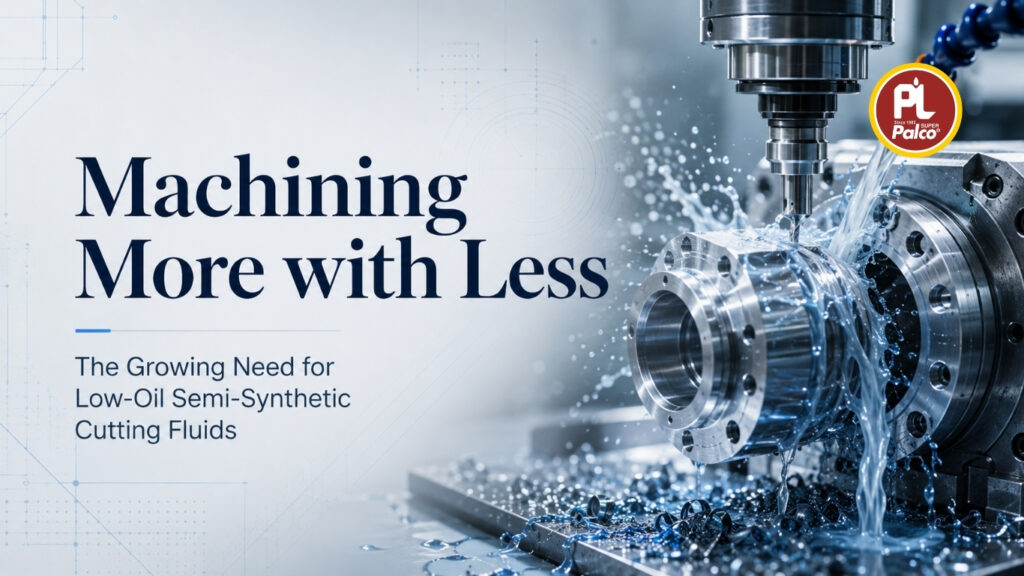
Machining More with Less: The Growing Need for Low-Oil Semi-Synthetic Cutting Fluids
Manufacturing has always been driven by a simple but demanding question: how can more output be achieved with fewer resources?
Today, this question has become more important than ever. Manufacturers are expected to increase production, improve component quality, extend tool life, reduce downtime, control operating costs, and meet increasingly strict environmental and workplace standards. At the same time, machining operations are becoming faster, more precise, and more complex.
Within this changing environment, metalworking fluids can no longer be viewed as routine consumables. They are an important part of the manufacturing process and can directly influence machining efficiency, tool performance, component finish, equipment cleanliness, and overall production economics.
This is where low-oil semi-synthetic cutting fluids are gaining strategic importance.
These fluids are designed to offer the cooling efficiency of water-based systems while retaining sufficient lubricity for demanding machining operations. Their lower mineral oil content supports cleaner operations, better fluid stability, and more efficient use of resources. The objective is not simply to reduce the amount of oil used. It is to create a more balanced machining environment in which productivity, performance, cost control, and sustainability can work together.
The Changing Demands of Modern Machining
Machining operations today are significantly different from those of the past.
Modern machine tools operate at higher speeds and tighter tolerances. Components are manufactured using a wider variety of materials, including alloy steels, aluminium alloys, cast iron, and other technically demanding metals. Manufacturers are also required to maintain consistent dimensional accuracy across large production volumes.
These conditions generate significant heat at the tool-workpiece interface. If this heat is not controlled effectively, it can lead to premature tool wear, dimensional variation, poor surface finish, thermal distortion, and reduced production consistency.
Traditionally, high-oil cutting fluids were preferred for their lubricating ability. However, a higher oil concentration does not automatically mean better overall machining performance. Excessive oil can reduce cooling efficiency, increase residue formation, create smoke or mist, affect machine cleanliness, and raise fluid consumption.
Modern manufacturing therefore requires a more intelligent balance between cooling and lubrication.
Low-oil semi-synthetic cutting fluids are formulated to provide this balance. They contain a controlled proportion of mineral oil combined with emulsifiers, lubricity additives, corrosion inhibitors, biocides, and other performance-enhancing components. When mixed with water at the recommended concentration, they form a stable, fine emulsion that supports both cooling and lubrication.
Why “More with Less” Is More Than a Cost-Saving Idea
The concept of machining more with less is sometimes interpreted only as reducing the cost of consumables. That is too narrow a view.
A cutting fluid may represent a relatively small percentage of the total manufacturing cost, but its influence extends across several areas of production. The wrong fluid can increase tool consumption, machine cleaning requirements, component rejection, fluid replacement frequency, and unplanned downtime.
The real economic value of a cutting fluid should therefore be evaluated through its effect on the complete machining system.
A well-formulated low-oil semi-synthetic cutting fluid can contribute to:
- Improved heat removal at the cutting zone
- Consistent tool performance
- Better component surface finish
- Reduced residue on machines and components
- Improved sump cleanliness
- Longer fluid service life
- Better corrosion protection
- Lower oil consumption
- Reduced smoke, mist, and workplace discomfort
- Easier maintenance and fluid monitoring
These benefits can collectively create far greater savings than the initial cost of the fluid itself.
At Paras Lubricants Limited, the development of metalworking fluids is approached from this wider operational perspective. A cutting fluid must not only perform during the cutting operation. It must also support productivity, machine reliability, operator comfort, maintenance efficiency, and long-term cost control.
Cooling Efficiency Becomes More Important at Higher Speeds
As machining speeds increase, more heat is generated in a shorter period of time. This makes cooling one of the most critical functions of the metalworking fluid.
Water has significantly better heat-removal capability than mineral oil. Low-oil semi-synthetic cutting fluids take advantage of this characteristic by using water as the primary cooling medium while maintaining a carefully controlled oil and additive content for lubrication.
This improved cooling can help maintain dimensional stability, particularly during high-speed machining and repetitive production cycles. It can also reduce the thermal load on cutting tools and components.
However, reducing oil content without maintaining adequate lubricity can create its own problems. Poorly formulated products may lead to excessive tool wear, poor surface finish, or instability under demanding conditions.
The value of a semi-synthetic fluid therefore lies in formulation quality. The challenge is to use less oil without compromising the protective film required at the cutting interface.
This requires a precise combination of base fluids, lubricity agents, extreme-pressure additives, corrosion inhibitors, emulsification technology, and biological control.
Cleaner Machines and More Controlled Workspaces
One of the most visible advantages of low-oil semi-synthetic cutting fluids is improved machine cleanliness.
Higher-oil emulsions can leave sticky deposits on machine surfaces, enclosures, filters, conveyors, and components. Over time, these deposits may attract metal fines and dirt, making maintenance more difficult and affecting the overall condition of the machine.
Low-oil semi-synthetic systems generally produce lighter and cleaner residues when properly maintained. This can reduce machine cleaning requirements and improve visibility inside enclosed machining areas.
Cleaner fluids can also reduce smoke and oil mist, particularly when compared with heavier oil-based systems. This is important not only from a housekeeping perspective but also for operator comfort and workplace management.
A cleaner production environment often reflects a more controlled process. It allows abnormalities such as leakage, microbial growth, contamination, or unusual residue formation to be identified more quickly.
Fluid Life Depends on More Than the Product
A premium cutting fluid cannot deliver its full value unless it is managed correctly.
The performance of a water-miscible metalworking fluid depends on several operating factors, including:
- Water hardness and chloride content
- Mixing procedure
- Fluid concentration
- Sump cleanliness
- Tramp oil contamination
- Filtration efficiency
- Microbial control
- Operating temperature
- Fluid circulation
- System design
Incorrect mixing can destabilise the emulsion. Excessively low concentration may reduce corrosion protection and biological resistance, while excessively high concentration can increase residue, foaming, cost, and operator discomfort.
The correct approach is to add the concentrate gradually into water while maintaining proper agitation. The concentration should then be monitored using a calibrated refractometer and adjusted according to the machining operation.
Tramp oil should also be removed regularly. Hydraulic oil, slideway oil, and other leaked lubricants can form a surface layer over the cutting fluid, restricting oxygen transfer and encouraging anaerobic bacterial activity.
Therefore, the move towards low-oil semi-synthetic cutting fluids should be accompanied by disciplined fluid-management practices.
The product and the process must work together.
Supporting Tool Life and Surface Quality
Cutting tools are among the most significant recurring costs in machining operations. Even a modest improvement in tool life can create substantial savings across a high-volume production environment.
Low-oil semi-synthetic cutting fluids help control tool temperature while providing lubricity at the tool-workpiece interface. This can reduce friction, minimise built-up edge formation, and support more consistent cutting conditions.
The result may include better surface finish, improved dimensional accuracy, and reduced tool replacement frequency.
However, fluid selection must always be aligned with the specific application. A fluid suitable for general CNC machining may not be ideal for heavy broaching, deep-hole drilling, difficult tapping, or severe forming operations.
Important selection factors include:
- Type of metal being machined
- Cutting speed and feed rate
- Tool material
- Machine design
- Filtration system
- Surface-finish requirement
- Water quality
- Severity of the operation
- Compatibility with seals and machine components
The best fluid is not necessarily the one with the highest oil content or the largest number of additives. It is the one that delivers the required performance with the lowest overall operational burden.
Reduced Oil Consumption and Responsible Manufacturing
Manufacturers are under increasing pressure to improve resource efficiency and reduce waste. While productivity remains essential, the method through which productivity is achieved is receiving greater attention.
Low-oil semi-synthetic cutting fluids can support these objectives by reducing dependency on mineral oil while maintaining the performance needed for a wide range of machining operations.
Lower oil content can contribute to reduced residue, easier system cleaning, and more efficient fluid disposal or treatment. Longer sump life can further reduce the frequency of fluid replacement and the volume of waste generated.
This does not mean that every operation should immediately shift to the lowest possible oil content. Responsible fluid selection must be based on technical suitability rather than a single environmental or cost parameter.
The objective should be optimisation, not reduction without purpose.
At Paras Lubricants Limited, the focus remains on developing solutions that align machining performance with practical manufacturing requirements. The right fluid should help a manufacturer produce efficiently while using oil, water, energy, tools, and maintenance resources more responsibly.
The Commercial Perspective: Evaluating Total Cost
From a management perspective, cutting fluids should be evaluated through total cost of operation rather than purchase price per litre.
A lower-priced product may appear economical but can become expensive if it causes frequent sump changes, corrosion, tool wear, foaming, excessive consumption, or component rejection.
Similarly, a premium product must justify its value through measurable improvements.
Manufacturers should monitor indicators such as:
- Fluid consumption per component
- Tool life
- Sump life
- Rejection rate
- Surface-finish consistency
- Machine-cleaning frequency
- Downtime related to fluid maintenance
- Corrosion incidents
- Operator complaints
- Waste-treatment volume
This data creates a more accurate understanding of fluid performance.
The correct question is not, “How much does the cutting fluid cost?”
The correct question is, “How much does the entire machining process cost when this fluid is used?”
That distinction is essential.
A More Intelligent Future for Metalworking Fluids
The future of machining will demand greater precision, automation, process visibility, and resource efficiency. Metalworking fluids will need to evolve alongside machines, cutting tools, materials, and production systems.
Low-oil semi-synthetic cutting fluids represent an important part of this evolution because they address several manufacturing priorities simultaneously. They provide efficient cooling, controlled lubrication, cleaner operation, lower oil usage, and the potential for longer fluid life.
Their real value, however, depends on correct formulation, application-specific selection, disciplined maintenance, and continuous performance monitoring.
Paras Lubricants Limited continues to view metalworking fluids as productivity tools rather than ordinary consumables. The emphasis must remain on creating formulations that help manufacturers achieve consistent performance while controlling the total cost and complexity of their operations.
Conclusion
Can manufacturers machine more with less?
Yes, but not by making random reductions or compromising essential performance.
The answer lies in improving the efficiency of the complete machining system.
Low-oil semi-synthetic cutting fluids demonstrate how advanced formulation can reduce dependence on mineral oil while preserving the cooling, lubrication, corrosion protection, and stability required by modern manufacturing.
They help shift the discussion from how much fluid is being used to how effectively the fluid is supporting production.
In an industry where every tool change, rejected component, maintenance shutdown, and litre of wasted fluid has a financial impact, this shift is significant. Machining more with less is not simply about reducing inputs. It is about extracting greater value from every input through better technology, better process control, and better decision-making.