
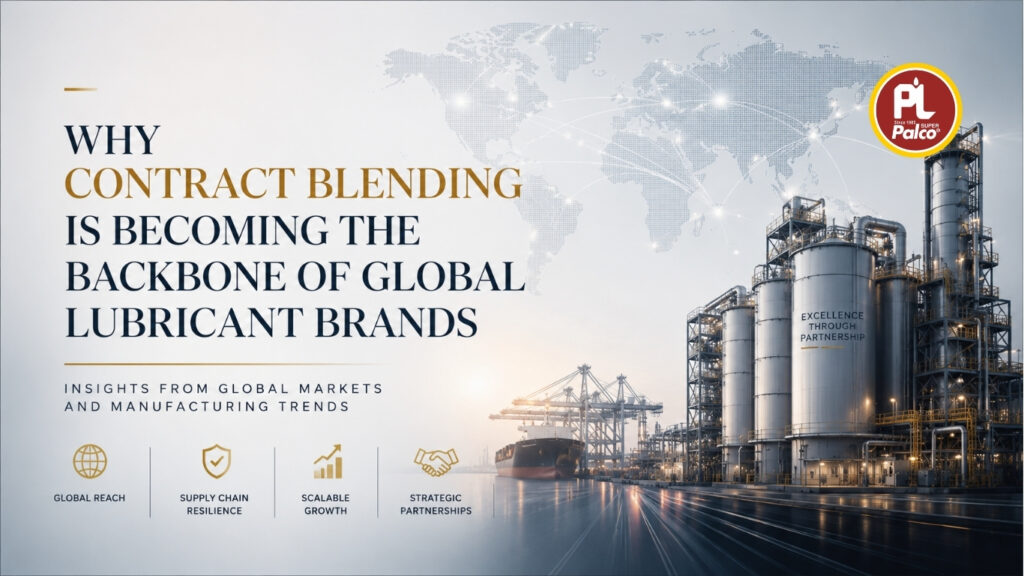
Build your lubricant brand with trusted contract blending services that deliver consistent quality, custom formulations, and reliable production support.
Having worked extensively across international lubricant markets, we have witnessed a significant shift in how lubricant brands approach manufacturing and expansion.
What was once considered a supplementary production model has evolved into a core business strategy. Across global markets, lubricant marketers, industrial brands, distributors, and OEM-focused businesses are increasingly seeking manufacturing models that offer flexibility, efficiency, and scalability without requiring substantial capital investment.
The lubricant industry itself is undergoing a profound transformation. For decades, success was largely determined by manufacturing ownership, production scale, and geographic reach. Today, however, the dynamics of global business are changing rapidly. Supply chain disruptions, geopolitical uncertainty, evolving regulations, fluctuating raw material costs, and increasing customer expectations are forcing lubricant brands to rethink traditional approaches to growth.
In this environment, contract blending has emerged not merely as a manufacturing solution but as a strategic business model. Across both mature and emerging markets, organizations are leveraging contract blending partnerships to accelerate market entry, optimize costs, reduce operational complexity, and improve responsiveness to changing customer demands.
The New Economics of Lubricant Manufacturing
The shift is being driven by a simple reality: brands today must move faster than ever before. Market opportunities emerge quickly, customer requirements evolve constantly, and product portfolios continue to expand. Building and maintaining manufacturing infrastructure capable of supporting such demands requires significant capital investment, ongoing operational expenditure, technical expertise, and regulatory oversight.
For many organizations, allocating resources toward production assets no longer represents the most effective use of capital. Instead, companies are increasingly focusing investments on innovation, customer engagement, brand development, distribution networks, and market expansion while relying on specialized manufacturing partners for production execution. This strategic reallocation allows brands to remain agile while maintaining access to world-class manufacturing capabilities.
The global lubricant market has also become increasingly specialized. Customers are no longer satisfied with generic products. Industries now demand lubricants tailored to specific operating conditions, equipment requirements, environmental standards, and performance expectations. As product complexity increases, manufacturing becomes more challenging. Modern formulations often require advanced blending technologies, stringent quality controls, specialized additive handling systems, and comprehensive testing protocols.
Leading contract blending organizations invest heavily in these capabilities, enabling lubricant brands to access sophisticated manufacturing infrastructure without the burden of building it themselves.
Why Manufacturing Capability Still Matters
However, the success of contract blending ultimately depends on the strength of the manufacturing partner. In today’s competitive environment, lubricant brands are looking beyond production capacity alone. They seek partners capable of delivering technical expertise, quality consistency, regulatory compliance, supply chain reliability, and long-term operational stability.
At Paras Lubricants Limited, our manufacturing operations in Daman have been developed to support these evolving industry expectations. With advanced blending infrastructure, quality assurance systems, and export-focused operational processes, the facility serves customers across diverse domestic and international markets. The current geopolitical environment has further reinforced the importance of manufacturing resilience. Despite disruptions affecting global trade and logistics networks, maintaining uninterrupted production and dependable supply has become a critical differentiator for contract blending partners worldwide.
Today, lubricant brands increasingly expect contract blending partners to provide:
- Consistent product quality across markets and production batches
- Strong quality assurance and testing capabilities
- Regulatory and documentation expertise
- Flexible packaging and private-label solutions
- Reliable supply chain and logistics support
- Scalable manufacturing capacity for future growth
Speed-to-Market Has Become Critical
Another major factor driving adoption is speed-to-market.
In today’s competitive environment, being first often provides a substantial advantage. Whether entering a new geography, launching a specialized industrial lubricant, or responding to emerging customer requirements, delays can result in lost opportunities. Establishing a manufacturing facility is a complex process that can take years to complete. Beyond construction, organizations must secure permits, establish supply chains, recruit skilled personnel, implement quality systems, and achieve regulatory approvals.
Contract blending eliminates much of this complexity. Brands can leverage existing infrastructure and established operational frameworks, significantly reducing the time required to bring products to market. This capability is particularly valuable in emerging economies and rapidly developing industrial sectors where market conditions can change quickly.
Geopolitics and the Need for Supply Chain Resilience
Global supply chain resilience has also become a defining business priority. Recent years have demonstrated how vulnerable international supply chains can be to disruption. Geopolitical conflicts, shipping constraints, raw material shortages, trade restrictions, and economic volatility have exposed weaknesses in traditional manufacturing models.
As a result, companies are increasingly seeking operational structures that allow them to adapt quickly to changing circumstances. Contract blending provides an effective solution by creating manufacturing flexibility. Rather than depending exclusively on a single production facility or geographic region, lubricant brands can establish diversified manufacturing strategies supported by trusted production partners. This flexibility helps reduce operational risk while ensuring continuity of supply, an increasingly important consideration for industrial customers who depend on lubricant availability to maintain critical operations.
Navigating Compliance and Sustainability
Regulatory compliance is another area where contract blending offers significant advantages. Lubricant manufacturers today must navigate a growing web of environmental regulations, product standards, documentation requirements, and quality certifications. Compliance expectations vary across regions and continue to evolve.
Maintaining compliance requires specialized expertise, robust quality management systems, and continuous monitoring of regulatory developments. Established contract blending organizations often possess extensive experience in managing these requirements. Their dedicated quality assurance teams, laboratory capabilities, and certification frameworks help ensure that products consistently meet international standards and customer expectations.
Sustainability considerations are further accelerating the adoption of contract blending. Customers, investors, and regulatory authorities increasingly expect organizations to demonstrate environmental responsibility while maintaining profitability and operational efficiency. Contract blending can contribute to sustainability objectives by optimizing production resources, reducing redundant infrastructure, improving manufacturing efficiency, and supporting localized production strategies that minimize transportation requirements.
The Rise of Private-Label Lubricants
The growing importance of private-label lubricants is another factor reshaping the industry. Distributors, industrial suppliers, equipment manufacturers, and service organizations are increasingly launching proprietary lubricant brands to strengthen customer relationships and create differentiated market offerings. Most of these organizations do not possess in-house manufacturing capabilities. Contract blending provides the technical foundation that enables them to participate effectively in the lubricant market while focusing on branding, customer acquisition, and distribution.
From Manufacturer to Strategic Partner
However, successful contract blending extends far beyond manufacturing capacity. The most effective partnerships are built on technical collaboration, transparency, quality consistency, supply chain reliability, and long-term strategic alignment. Modern lubricant brands seek partners capable of contributing not only production expertise but also formulation support, regulatory guidance, packaging solutions, logistics coordination, and market-specific insights.
In many respects, contract blenders have evolved into strategic business partners rather than simply manufacturing service providers.
Looking ahead, the role of contract blending is likely to become even more significant. The lubricant industry will continue facing pressures related to market volatility, technological advancement, sustainability requirements, and global competition. Organizations that maintain flexibility while controlling costs will be better positioned to navigate these challenges successfully.
The future of the lubricant industry will not necessarily belong to companies that own the most manufacturing assets. Instead, it will belong to organizations that can build the most resilient, agile, and strategically aligned business ecosystems. Contract blending provides precisely that balance, allowing brands to scale efficiently, respond rapidly to market opportunities, manage risk effectively, and focus resources on activities that drive long-term growth and differentiation.
In that future, contract blending will not simply be a production model. It will continue to serve as one of the most important foundations supporting the growth of global lubricant brands.